My four days of hell are (almost) over

Back after 1 hard weekend of moving.

Those more attentive of you might have noticed that in the last few days I haven’t been very active online. Not many posts, twits and whatnot. The reason is that I’ve been preparing to move to a new flat down to the road and finally this long weekend we went through the hellish task of renovating and moving.

I’m still hurting.

I don’t have internet anymore.

My previous landlord has dissapeared from the face of the earth with 1k of my deposit.

I don’t have a place to put my PC anymore.

I’m still hurting.

All in all, some good fun. I just don’t want to be moving for the next 10 years.

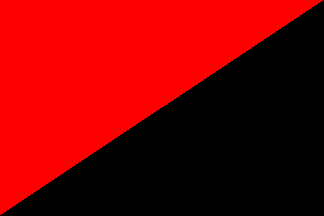
On the bright side, I finally got a room in the colour I always wanted. It looks something like this 😉

Pics will follow.

Can market exchange create new value?

No misconception is more common among free market proponents than the idea that simple exchange creates new value. I wish to show how this reasoning is flawed.

free lunch
Image by arbeer.de via Flickr

A very common argument from economists and generally free market proponents is that the only thing that creates value are market interactions.  The basic idea they try to promote is that the Capitalist system is not a zero sum game as one person’s gain does not need to come from another person’s loss. You can see an example of this argument from this latest post on Techdirt.

Too many people, it seems, assume that “there is no free lunch” means that the market is entirely static. That is, they believe it’s a zero sum game. If I do x, then y loses out. So, if I am offered free internet service or a free lunch, then whoever provided that is out the same. But that’s simply not true. Economics is not a zero sum game, but is built around economic growth — where the sum of economic activity can be greater than the parts. If I do a transaction with you, and in the end, we’re both better off (i.e., we both got more value than we gave up), then the amount of overall value in the world increased. It might not be a “free” lunch (the economic transaction cost me something), but new utility is created above and beyond what was there before.

(Emphasis mine)

I will not argue on the liberal use of vague concepts and examples that seem valid (eg Why “Free Internet” and not “Free Apples”? Because the argument sounds more plausible that way) but I will point out the black hole in the end.

What the author is telling us in effect is that when you and I trade commodities, new utility is created. So if I give you an apple and you give me an orange, new utility has been created out of thin air. What this utility is, the author does not deem worthy to mention so your guess is as good as mine.

We can safely assume that the author is rather talking about utility in the economic sense, which can roughly translate as satisfaction. In that case however, new utility has not been created but rather the individual utility of each person has been increased. But this kind of utility does not affect the cumulative value of the world, it only affects the individual. The amount of value in the world remains constant.

It is this kind of fallacious reasoning that leads to events such as the rise and fall of Iceland, where their “value” skyrocketed simple because the traders agreed upon themselves that their stuff was worth more. What they basically did was trade amongst themselves and with each trade, they were creating “new utility”. By the logic above, that is perfectly normal and acceptable. The result of which was that Iceland’s “wealth” ballooned to such an extraordinary degree and then popped at the slightest disturbance.

But the reality is that utility, and by that I mean objective value of any single commodity can only be created through one of two ways. Human Labour and Natural Phenomena. The only way to create a new car is to build it. The only way to create a new microchip is to build it etc. It is funny that the author quotes someone else who goes very close to this but fails to grasp it

A useful metaphor for production in an economy comes from the kitchen. To create valuable final products, we mix inexpensive ingredients together according to a recipe. The cooking one can do is limited by the supply of ingredients, and most cooking in the economy produces undesirable side effects.

But of course the extra value that is created in the kitchen does not come from simply possesing lots of inexpensive ingredients. By this reasoning, the best cooks would be the ones who could trade their material best and get the biggest array of them, or trade for the ones that gives them personally the largest amount of satisfaction. After all it’s the trading that would “create new utility” and thus “value” isn’t it?

But that of course is patently absurd. The extra value that is created in the kitchen does not lie in the ingredients. It lies in the amount of labour the cook will put in his cooking. And if we take into account the skill of the cook, then we can speak about the SNLT to be more accurate. The more labour the cook puts into his cooking, the more value the end result will have.

It is understandable that economists would be avert to recognise where the value comes from, but this dooms them to simply a series of equivocations.

Reblog this post [with Zemanta]

Socialism doesn't apply via self-description

Should we take those who call themselves “Socialist” at their word? Anti-Socialists seem eager to do so but such a label can only be assigned by act, not by word

Socialists in Union Square, N.Y.C. [large crow...
Image by The Library of Congress via Flickr

Db0: A reader recently contacted me asking if he could write an article on Socialism and have it posted at the Division by Zer0. Since WordPress provides the capability to have multiple users and since the contributor role already exists and since writing has been slow around here lately, why not? Following you’ll find the opinion of Orgthingy from (I assume) France, edited for clarity by yours truly.


Whenever I mention that I’m a socialist, many point out that I’m a “Communist Nazi” or “Racist Bastard”, when I ask how’s being socialist racist, they answer “Nazis are National SOCIALISTS YOU RACIST BASTARD GO TO HELL!”; it basically annoys me.

Hitler, Stalin, Saddam Hussein, and other “dictators” are nothing but the usual: Dictators that use the Communist and Socialist noble messages to satisfy themselves. Hitler didn’t provide jobs by his “Creative and evil Socialist ideas” but rather to kill the Jews (and others) so the Aryan-blooded Germans would think he actually created jobs for them.  He didn’t. Socialism isn’t about satisfying anybody by killing others.

Now Stalin’s turn, USSR wasn’t Socialist/Communist at all, but State Capitalist. Stalin was a control-freak, but not every kind of control means “The Socialist Devil”; Capitalism has its kind of control as well, but people just don’t know.

Now it’s Saddam’s turn: His country had billions of dollars ,before he became president, flowing into country’s revenue, then he made his country billions in debt! After googling I found out that he spent the money either on weapons or for personal use; that really isn’t socialism.

People Wake up, just because they claim they’re socialists doesn’t mean they are!


Db0: Orgthingy is pointing out the classic fallacy of taking Dictators at their word on whatever they claim to be. Thus Stalin was a “Communist”, Hitler a “Socialist” etc. The people who accept such a self-definition by dictators and brutal regimes are guilty of intellectual dishonesty, for they won’t as readily accept, say, the claims of North Korea of being a “Democratic Republic”, nor would they accept claims of such people that their acts are for the greater good and whatnot.

It is obvious that a dictator will attempt to provide legitimacy to their rule. It will always be “for the people” or “for the nation” and any other such rhetorhic. The specifics will not matter but it will be whatever most people believe in. As such the dictators of USSR called themselves Communists, and the fascists of Germany called themselves National Socialists (as Socialism back then was still quite popular).

However to believe one thing those Leaders say but dismiss the other is simply disingenuous. Especially since what they claim to be has a perfectly clear definition already which diverges from their actual practices. For example, Socialism is supposed to be Worker’s ownership of the means of production and egalitarianism, but National socialists promoted exactly the opposite. Their regime was defined by a strict hierarchical pyramid of power and corporate cronyism, where economic freedom was high but political freedom low. Indeed, Capitalists all over the world loved the Nazis (as they have loved every other fascist/right-wing dictator since).

The rulers of any country will hijack the ideology that is most popular at the moment in order to retain their rule with the minimum of resistance. Nazi leaders gave the illusion of working for the good of the German people (National “Socialism”) while the USA ruling elite give the illusion of allowing power and choice for everyone (“Democracy”). None of these have much legitimacy and nor do they necessarily merge with what others mean when they say “Socialism” or “Democracy”. These labels do not work through self-identification.

Reblog this post [with Zemanta]