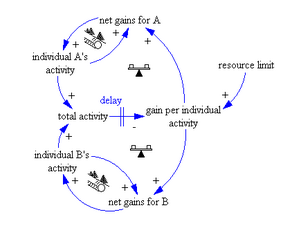
- Image via Wikipedia

The latest and hopefully the final nail has been driven in that old-time favorite myth against all forms of communal ownership, the Tragedy of the Commons. Elinor Ostrom has just received the Nobel Prize Bank of Sweden Prize in Economics in Memory of Alfred Nobel for her extensive work in debunking the Tragedy of the Commons myth. ((h/t to Francois))
And I couldn’t be happier. This annoying idea has been frequently cited (bur rarely read) by statists and propertarians alike as an argument in favour of state-control or privatization in order to avoid admitting that people could manage their own resources without a government bureaucrat or profit-seeking landlord giving the orders above. Even though many others have already countered this theory in depth, this is the first time (that I know of) that not only the refutation reaches the mainstream but is so well proven and argued that it earns a coveted award.
Furthermore, this event is important for another reason, namely the current shift of economics from the ideological to the empirical. A Political Scientist, rather than an Economist has won the Economic Prize which hopefully marks the shift to the perception of how economics is done and what it tries to achieve. It is past time we put behind us scholastic theories such as praxeology and assumed axioms and focus on what has worked best for discovering knowledge for humans. It’s past time to leave Neoclassical, Austrian and Keynesian economics in the same old pile we left Pythagoreanism, Alchemy and Astrology. It’s past time economics became a science.
The Tragedy of the Commons is the latest such casualy and hopefully it won’t be the last.
And I’m dancing on its grave.
![Reblog this post [with Zemanta]](https://i0.wp.com/img.zemanta.com/reblog_e.png?w=980)
Yes, let this be the LAST nail in the coffin! Oh my god, I'm so sick of that BS still being used as an argument by economics "experts." It's like they don't bother to do research.
"It's like"…? o.0
Well, let’s be clear: we’re rejecting the tragedy of the commons as a kneejerk dismissal of any common ownership scheme. That doesn’t mean you can’t have a tragedy of the commons. It just means that, unlike what vulgar libertarians claim, it’s not *necessarily* involved in commonly owned property. In other words, it’s *possible* to manage property owned in common in an efficient and conservative manner.
Right?
But that's the whole point of it being a "Tragedy" Jeremy. It's supposed to be a Tragedy because this mismanagement of the commons is impossible to avoid. We all know that people can mismanage resources, whether those are state-owned, private or common, but this theory suggested that the common one's couldn't but be mismanaged.
Look, I take a back seat to no man in advocating voluntary and decentralized solutions to managing property in common. That said, I merely wish that we understand what's going on here. Ostrom herself says that the tragedy argument is merely "overstated", which fits in with what I'm saying. The phenomenon of long-term resource depletion occurring due to short term self interest exists still, but it's not the immutable law it once was treated as.
However, I share your enthusiasm in using this new research as a weapon against ancaps and all others enemies of more social constructions of resource management.
But this is the thing, the research Ostrom has done does not merely prove that the Tragedy is not widespread but that it doesn't apply to the commons. I applies to state-managed and unowned (aka free-for-all) resources but commons have the checks and balances to avoid the Tragedy by the nature of the common.
"Tragedy of Commons", as I understand it, is when the ownership/rights/property is poorly defined, or not at all defined, (e.g., unowned/free-for-all) mismanagement is bound to happen. (A necessary condition.)
As you note, however, "The commons" as a communally-owned resource is not the same thing as an unowned/free-for-all. With regards to "the commons", these things are defined (even if relatively informally) and so the necessary condition for tragedy is lacking.
Now, whether are guilty of extrapolating unfairly, or equivocating, is another question altogether.
There has, historically speaking, been no tragedy of the commons. It was a logical scenario dreamed up by Garrett Hardin, but later taken as fact. Again, yet another example of convenient economic myth served up as truth and gaining widespread acceptance because it benefits certain interests, ie seemed to argue against collective ownership. As far as I remember, the origins of the thesis were inspired by (or at least had parallels with) the arguments put forward by apologists for the enclosure movement in Great Britain a couple of centuries ago.
Is it quite so simple? I remember having to read and discuss this work for a Green Poliitcs course I undertook a few years ago – several in fact now I come to think of it! – and the main conclusion we drew from it was that, actually, the "commons", by which we took Hardin to mean the wealth provided by Nature, needed greater [i]collective[/i] regulation. In the end, his view is fully compatible, I think, with a libertarian socialist view that only by collective management of natural resources will we all benefit in the end. Indeed, historical studies of former societies have shown that people were adept at managing resources collectively. (Hardin, iirc, mixes up the economic logic of one epoch with the economic/legal framework of another).
If nothing else, though, the moral of the story – that the individual pursuit of economic self-interest destroys commonly held resources to the detriment of all – rings true. Think of fish stocks, for instance, or CO2 emissions, etc., etc.
And if the fish stocks, or CO2 emissions were properly defined property rights? Gubament fails again, private ownership wins.
I recently got her book, "Governing the Commons." I haven't cracked into it just yet because I'm busy with school, but I'm really excited to read it and I'm happy she was recognized for an award for this idea. It's nice to see places with well-managed public resources (eg: New Zealand/Australia) are being recognized, too. I recently read in a surveying magazine that many farmers there have cut through bureaucracy by working together to create bottom-up solutions to their agriculture & mapping problems, where equipment is too expensive for any individual farmer to afford or maintain. They do it all on their own, no state subsidies or anything, and apparently it's quite efficient with little or no waste. Very cool stuff.
I have a debate tomorrow, and I need to explain why the tradgedy of the commons is false.There is not alot of information about the anti tradgedy of the commons, however I need to refute the ideas behing the tradgedy…please HELP
Check the collection of links I've saved here: http://sqworl.com/0wizk5