The Barefoot Bum strikes back and the ethics of blogging.

The Barefoot Bum finally reacts to my condemnation of his actions. His response unfortunately falls short of the point.

8 12 09 Bearman Cartoon Freedom of Speech
Image by Bearman2007 via Flickr

…Sort of. In response to my internet drama post about banning me from his blog and my thoughts about it and his past actions he’s come out to clarify his position and why nobody deserves to call him an enemy of free speech or whatever. Of course that would actually be a valid defense if I had claimed that he was an enemy of free speech and open debate. Which, you know, I haven’t.

The Barefoot Bum thus, unwittingly, provides us with a perfect example to talk about blogger ethics and go further on why his actions were objectionable. ((Really, It’s not worth wasting any more bytes explaining how he didn’t understand why I was annoyed at him. My post is quite clear on this even though Larry picked the parts which were the easiest to misrepresent and proceeded to do so.))

He claims that he has no obligation to publish comments or be as nice to commentators and thus implies that shouldn’t be criticized for not doing that. He also claims that he doesn’t object to others criticizing them at their own locations…within a blogpost whining about me criticizing him at my own blog. The Irony is delicious once more.

But what he has failed to grasp is that I’m not criticizing him for being a hypocrite or an enemy of free speech. I’m criticizing him for being an arrogant elitist, for being a dick to people who don’t deserve it and for being hypocritical about being a “a honest seeker of truth” when he dismisses arguments which do not fit into his preconceptions.

His comment policy fits nicely into this picture since it’s a policy which works quite different from the examples he mentions about “no comments”, “no replies from the office”, and “open to all but trolls”. Putting aside the fact that any and all those comment policies can and should be discussed and criticized just as well, his own policy of “comments are heavily moderated and discouraged” is very vague on its guidelines and judging from the examples of what he ends up banning can thus be condemned for the thin excuse for intolerance of different opinions it is. Just because it’s his  policy in his own blog does not allow him to escape this, and this is precisely what I did.

One might ask, as he proceeds to do, why didn’t I do this before? Why I didn’t criticize his comment practices (or his Maoist tendencies) before this drama occurred. The answer is quite simply because I used to consider him an online friend at some point in the past and thus was trying to tactfully point out the errors of his positions without putting it bluntly and thus forcing him on the defensive which would have simply ended up with us speaking past each other. This is only common (n)etiquette between friends and acquaintances really as you’re trying to change the other’s position without breaking up all relations in the meantime. My attempts were especially cautious furthermore as I knew firsthand his intolerance and thus slow. But it was there, in the various counter-arguments I made in his comments and in this blog as well.

Of course, what ended up happening is that the more clearly I started opposing his position, the more annoyed he became at me and the more cold and stressed our interactions became. Still I kept hope that he would be willing to listen to opposing opinions  from someone who’s opinion he used to respect and thus I decided not to come out and condemn him openly until he took the first step to force my hand as I expected him to do, and as he proceeded to do. Instead of thinking why someone he used to read and agree with started arguing against his positions, he took the easier solution to consider that I must have somehow become stupid in the meantime and therefore not worth listening to.

In fact, this etiquette is what Larry seems to be severely lacking and something that he also deserves to be condemned for just as well. His reaction to people who express a different opinion is horrendous. He will accuse them of stupidity or “fucktardery” (to use his own words) at the drop of a hat and thus only manages to discourage and avoid dialogue. Is it no wonder why I consider such knee-jerk reactions counter-productive and do not follow them? And this is precisely the reason I now openly take the time and condemn Larry’s intolerant behavior. Because I wish to discourage it.

I don’t have any illusions that Larry will learn from this of course but he does serve as a great example of how not to act if you’re really looking for truth. Shutting down dialogue, especially when the other side is not being deliberately trollish or aggressive, is not in your interests as a freethinker. Larry may be too far gone with far too thin a skin to save but hopefully the rest of you aren’t.

For closing I am going to address Larry’s contention that he’s not a Maoist because he’s not explicitly said so. A claim so ridiculous on its face that I shouldn’t have to address anyway but I’ll do this just in case one can’t see it. Very much like Socialism or most other political theories do not apply via self-description, so does the opposite hold true as well: The lack of a self-described label does not automatically exclude one from the theory. Larry makes the fallacious reasoning that people are not a “Hitlerites” either simply for being vegetarians nonsmokers, missing the point that those factors do not a Nazi make. However someone who was intolerant to non-Aryan races and homosexuals and also an anti-semite would probably strongly point to Nazi-tendencies. Similarly, the Barefoot Bum’s promotion of governmental communism, his support and apologetics for various Maoist policies, his fawning over Bob Avakian and the RPCUSA and finally his intolerance for opposing opinion in a true Marxist-Leninist fashion, do point out that strong Maoist-tendencies certainly exist in his political orientation, even though he has not explicitly endorsed the whole theory.

If it walks like a duck and it looks like a duck but it hasn’t actually quacked yet to confirm it, you are still warranted to have a very strong suspicion that it is, in fact, a duck.

Reblog this post [with Zemanta]

The Propertarian Double Standard

Kevin Carson in one quote expresses the reason why arguing with propertarians can be so frustrating, so often.

Bradoon
Image Unrelated via Wikipedia

From a reddit discussion I ended up discovering a post from Kevin Carson who expresses amazingly well the reason why I keep getting annoyed when discussing with propertarians of various forms. It’s the implicit double standard that is implied every time I’m accused of wanting to steal stuff, of having no respect for the capitalist’s “labour”, of being authoritarian. I’ll let Carson put it best.

Here’s an opposing case for you: Imagine I’m renting a house under a Lockean property system, and get permission to plant a garden on it. I invest a lot of effort in composting and green manuring, and even spend money on granite dust, greensand, rock phosphate and the like to improve the soil. When I get done with it, what was hardpan clay has been transformed into rich, black, friable soil. And when I cease renting, I lose the value of all the improvements I made. That’s the sort of thing that happens all the time under Lockeanism. But I suspect that Reisman would say that I made the improvements with my eyes open, and am entitled to no sympathy because I knew what the rules were. I certainly doubt that he’s shedding any tears over the invested labor that the South Central Farmers are in danger of losing.

The difference is, when it happens under the system he’s defending, it’s just life; when it happens under the system he’s demonizing, it’s an outrage.

And this here above is exactly the thing you get to hear all the goddamn time!

The wage-worker not keeping the full value of his labour or his labour not being enough to ensure his subsistence? That’s just life. A wannabe-capitalist not being able to extract a profit from his workers? Outrage!

A tenant-farmer’s labour not being enough to homestead the land he’s working on because a landlord has already a claim to it? That’s just life. Someone not being able to claim ownership on more land than he can possibly use himself? Outrage!

Capitalists requiring a special class of wealthy judges to interpret the “libertarian law” and a private defense complex to enforce them? That’s not a state, just life. Workers banding together and using means such as peer pressure and ostracism to enforce that nobody exploits and dominates anyone else? Outrage! Statism!

I could go on and on but you get the idea. It would be funny if it wasn’t depressing to have to argue against this so often.

This whole thing starts from the classic error of the propertarians taking their chosen system of ownership as given and a “natural law”. Once you start by assuming that Private Property is an objective rule set then it’s not difficult to jump to the conclusion that act that violates those rights is an outrage. The fact that it is not a violation when the whole system has been rejected simply does not cross one’s mind. It reminds me of some Liberal lawyers arguing that a violation of copyrights was wrong because it’s the law and not being able to grasp that we challenged the validity of the law in the first place.

Reblog this post [with Zemanta]

Mushrooms

Photos from my mushrooms

One and a half month ago I went to my girlfriend’s village for a visit to her mother. A trip to the nearby forest alerted us to the existence of an insane amount of Mushrooms. These are the pictures we took.

We weren’t looking for just anything of course. Mostly we were looking for Steinpilze and their family. We ended up with a huge haul.

We’ve got enough of them to last us till spring at least 😀

This is certainly going to become a yearly event.

On First Principles

“Anarcho”-Capitalist request LibSocs to state their first principles in order to understand their worldview. I explain why this is entirely to wrong question to ask.

Abstract Principles Taken to Their Logical Ext...
Image via Wikipedia

In a recent conversation with Facebook ” Anarcho”-Capitalists I’ve been asked to provide an explanation of my beliefs starting from “First Principles”. As my initial answer didn’t seem to be enough, the same question was later posted, once more, in a location I couldn’t access ((h/t @Noor for letting me know and posting the discussion somewhere public)). I think this deserves an explanation on why it is entirely the wrong kind of question to ask when trying to understand Libertarian Socialism.

The confusion I believe starts from the way the Propertarians start to build their worldview. From what I understand about this point (and of course, I may be wrong – but concise information on this is not easy to find online) they declare a few particular normative propositions as inviolable or “true”, call them axioms or “first principles” and then build their ethical system from there. There’s no clear agreement on this but the axiom of Self-Onwership seems to be the primary basis on which the ideology is built. There are others like the Non-Aggression principle (Also called Zero-Aggression principle. NAP or ZAP) which may follow from Self-Ownership or may be asserted standalone.

I won’t go into details on why those “first principles” are flawed at the moment (soon though). The point is to explain why such propertarians expect someone to state their first principles initially so that they may grasp the concept. They just can’t contemplate a different way to reach a social framework than by starting from such “axioms” and when Anarchists point out that we don’t have any, they are unable to compute, as can be seen from the quote (from the discussion I linked above)

The implication is that logic is optional. She’ll deny it, of course, and say that she’s just not doing logic in the way that the oppressive capitalists demand, but it still amounts the the notion that logic itself is seen as a kind of oppression. It’s a religion.

The obvious flaw in this reasoning is that it is asserted that those first principles are the result of pure logic and therefore impossible to be flawed (thus the label of “axiom”). Of course if one starts from this assumption it is understandable that when someone else denies the necessity of “axioms” to base a socioeconomic theory on, they can be seen as denying logic itself.  But this is merely begging the question.

And this is where the biggest problem lies in this perspective. Using scholasticism (i.e. pure logic) to understand reality has been discredited for a while now and empiricism and inductive reasoning took its place. No matter how perfect one’s logic can seem, it’s very likely that some small errors or wrong assumptions have entered into it at some point, therefore leading to the wholly wrong results. Without empiricism thus, it impossible to find logical errors as there is nothing to compare the results with.

Thus (many? most? Well me at least.) Libertarian Socialists reject this perspective in favour of what has been shown to actually work in understanding and predicting reality. Science and Materialism. Talking for myself here, I find no reason to start from a principle of self-ownership (even if it wasn’t inconsistent) when I have the far better option to start from a (meta?)ethical question: “What bring the best results for the maximum amount of people?”. Starting from this question and then using scientific knowledge (on how humans behave and how human societies tend to work) we can try to compile a socioeconomic system which will achieve this result.

Adding a “first principle” such as the NAP or self-ownership would thus only come into the picture if it followed from the original question. Looking at it this way, one could call the Anarchist opposition to hierarchy and authority as a sort of “first principle” but not in the same absolute way as the AnCap ones are asserted but simply as means to an end.

And this is in the end why it’s completely misguided to ask an Anarchist what their “first principles” are. The most likely answer would be “Why do I need them?” and this is a perfectly valid response. To preempt those who would express the sentiment that having “First Principles” is obvious: It is not. The burden of proof is on people who assert that such principles are necessary to prove why this is so. An argument from obviousness just does not cut it as it’s far from obvious to me and many others.

I get the impression that people who assert that such first principles are necessary, are those who saw them expressed somewhere and immediately latched onto them as something that made obvious sense. Yes, it may make obvious sense but this does not make it an absolute or an objective fact of reality. There’s always the chance that there’s holes in the reasoning, or it does not make sense in some contexts. What I’m trying to say that even if something is making sense, it still does not validate the concept of “first principle”. This is akin to saying that because the golden rule makes sense, the Christian god exists.  It simply does not follow.

It is similarly  flawed thus to accept only a different set of first principles in order to counter your own ideology. It’s like a Christian asking someone trying to explain evolution to him, to first state which other deity they assert instead of the Christian god. A perfectly valid answer to both questions is still “None.”

Reblog this post [with Zemanta]

The Barefoot Bum is just not interested

The Barefoot Bum decided the best tactic to counter my criticisms would be to ban me from his blog. This is my parting shot.

And for your daily dose of internet drama…

I’ve been waiting for this to happen for a while and finally now, after the Barefoot Bum re-re-re-…-re-opened his blog I’ve finally been banned from commenting on it in no uncertain terms. He’s “just not interested” in what I have to say. This is after I simply pointed out that his speculations on the historical rise of capitalism are off-base as he misrepresents a lot of historical factors such as subsistence farming or the causation for wage-labour and thus may/will reach the wrong conclusions.

I was implicitly threatened with a ban if I did not “provide evidence” to counter his lack of evidence and then my subsequent comments providing some sources and explaining in direct terms that he cannot assert something and then demand evidence to disprove it, were deleted (or left unapproved more likely). Shortly after, I was informed via email that my input was not appreciated.

And this pissed me off.

Why did the random email from some random blogger piss me off? Because for good or bad I’ve had a friendly history with this particular blogger and in my dismay I’ve watched him descent more and more into intolerance and elitism as time went on. I’ve seen him ban friends, foes or simply well-meaning people for uttering words of criticism with the laughable excuse that they’re not “a honest seeker of truth”. I’ve seen him deliberately crap on my efforts to help him and did not even get as much back as a consistent apology (only some half-arsed mumblings about “Technical issues”). Back then I did not express publicly my annoyance at the way he treated me as I was willing to give him the benefit of a doubt on behalf of our friendly history, but enough is enough.

The Barefoot Bum has become the example of a blogger you want to avoid.

And it’s sad, you know? He was the type of blogger that I enjoyed linking people to and asking for his input for my own ideas. He has the type of sharp thinking that can accurately criticize socioeconomic issues such as the capitalist mode of production and reach some interesting and digestible conclusions. But his growing intolerance to simply being wrong is just off the fucking scale. Oh he’s just wonderful when he’s arguing against theism where he knows he’s right. I’ve seen him accept the most rampart hostility from theists with a chuckle, but don’t you dare challenge his nascent political beliefs and especially don’t you dare challenge them from a socialist perspective. Or he’ll shut down his blog!..Again.

Did I mention I’m pissed? Just in case you forgot.

For someone who prides in his “honest search for truth”, TBB is ridiculously closed to listening to constructive criticism or facts which go against his ideology. And don’t you dare do so in his blog without evidence he’ll agree on. His comments are just for praises after all. And you have something critical to say, you’d better post it where he can safely ignore it (i.e. your own blog) and continue as if no objections have been made to his errors and distortions.

And you know what the funny thing is? This change of character happens to correlate very nicely with his turn towards Maoism of all things! It’s like a perfect example of how flawed ideologies lead to flawed results, not only in practice but apparently in character as well. The more he started getting turning towards authoritarianism and “glorious leadership” as valid sociopolitical concepts, the more his own character started representing the nasty effects these concepts breed. It’s like a practical example of how character corrupting these ideologies are.

In any case, there’s nothing left to salvage here. This bridge is well and truly burnt and not worth rebuilding without some big changes. I do hope to be proven wrong and see Larry rethink his position and actually start hunting for truth with an open mind once more, but I don’t bet on it at this point. It is also probably time to also unsubscribe from his blog as there’s no point in reading analysis starting from flawed premises from an author who stubbornly refuses to consider this possibility.

Goodbye Barefoot Bum. I’m certain you’ll sleep better with the knowledge that your ban earned you a prominent place along with Objectivists and liars. I wash my hands of you.

UPDATE: Hey look, he’s just noticed this post and his response was his usual arrogant bullshit avoiding any substance. No, much easier to call me unintelligent and declare I’m not worth arguing with. I guess only stupid people can possibly disagree with the Barefoot Bum since everyone who does is labelled as such. As for Maoism, well, read his latest posts and make your own conclusions.

The 5 stages of "Anarcho"-Capitalist reaction.

From the first time an AnCap encounters a LibSoc for the first time, a common reaction is to be expected passing through 5 stages. Here’s a very scientific explanation of this effect.

.bless uS
Image unrelated by 27147 via Flickr

Every time I argue with Stateless (or minarchist) Propertarians of various degrees of vulgarity, I keep seeing a few types of reaction over and over. Not only are they common but they seem to follow in a very particular progression which made me think of the 5 stages of grief.

With the same lack of scientific accuracy then, I will now present you with the 5 stages of “Anarcho”-Capitalist reaction to Libertarian Socialists. For the lulz.

1. Surprise and Denial

“Libertarian Socialism? Isn’t that an oxymoron?”; “I can’t believe someone can support communism at this time and age.”; “You’re not a true Anarchist if you don’t support private property!”

Surprise usually occurs to those who have had a fairly sheltered political life and have only just began to radicalize recently by discovering Ayn Rand or Austrian Economics but have only the slightest experience with the wider libertarian movement or conceptions of Socialism outside of McCarthyian propaganda . It is quickly followed by denial as the position of LibSocs quickly assaults their recently acquired radicalism but disentangling the concept of liberty from the concept of property. For someone who has just recently embraced the NAP or the self-ownership principles as  true and inviolable, any direct challenge to those principles is likely to be dismissed out of hand.

2. Misunderstanding and Anger

“Stalin! Mao! Pol Pot!”; “Try to take over my house and I’ll shoot you!”; “You’re just a bunch of hippies dreaming of utopias. Get a job!”; “You’re just hate Capitalism because you’re lazy and jealous.”

This often follows and complements denial when the discussions continue for a any length of time. Occasionally someone may start from this position when he’s had discussions with LibSocs in the recent past as well. The reasons for such a reaction is generally the persistent assault on AnCap principles and the opposition to some basic building blocks such a the “Free Markets”, an opposition which is misunderstood as expression of authoritarianism. Another common cause is the misunderstanding of LibSoc positions, assuming that they support involuntary societal organization, such as forced collectivization or forbidding of trade. In general, As such discussion grows longer, the probability of comparing the LibSocs to Stalin, Mao, Pol Pot or their corresponding regimes approaches 1. (Db0’s Law?)

3. Bargaining

“Why don’t we put aside our differences and focus on toppling the state?”; “We would never be opposed to communes and co-operatives within Anarcho-Capitalism.”; “We’re all Libertarian socialists at the end of the day.”

The bargaining phase of the AnCap reaction tends to come as one’s understanding of the Anarchist position increases and they realize that they too are suggesting voluntary rather than coerced relations and social organization. Missing the point of Anarchists not considering voluntarism to be enough, they reach the flawed conclusion that the two movements are close enough to ally in opposition to the state. It is at this point that the crucial differences in tactics start to be expanded which can lead the discussion to back into Anger as AnCaps interpret refusals of potential alliance as stubborness or given convincing argument on why Agorism or “Libertarian” Reformism is not good enough to crush the state, they may descend into…

4. Depression

“The state is too powerful to topple.”; “I want to smash the state as much as anyone else but we need to find a way to do it peacefully.”; “I’m only an Anarchist ideologically. Practically we can’t change the system without making things worse.”; “The free market/internet/cryptography will lead to the state’s demise naturally.”; “Vote Ron Paul!”

The end of the road for the “Anarcho”-Capitalism movement remains firmly within the current system. While they have truly numerous criticisms of the state and quite a bit of perfect-society theories and literature, they are sorely lacking in transitional ideas. In short, they have no idea how to get from here to there and as a result they are stuck. There’s a lot of rationalization for this predicament of course, from claiming that they would only support “peaceful revolutions”, to insisting that they are waiting for most humans to turn AnCap due to their superior arguments to my all-time favourite, waiting for the internet to revolutionize society towards the direction they expect.

This is of course nothing but a way of giving up, of raising up their hands in frustration and devolving into wishful thinking. Those who take a more practical approach either turn to Agorism or Reformism as a best-next-solution. Supporting Socialist Revolutions and then trying to convince people to voluntary turn to propertarianism is of course out the question. One guesses because they realize the futility of achieving the later. Silently consenting to the current system is apparently a better option.

5. Acceptance

“Fine. What do you suggest we do?”; “If you don’t want to force me into collectives I have no problem with you doing your own thing.”;

This last step is usually irreversible. At this advanced stage, LibSoc ideas have finally started making sense, usually when coupled with real-life experience of wage-slavery and hierarchical domination. The veteran AnCap now understands the perspective of the LibSocs and knows better than to make egregious strawmen as he’s been in the same discussions too many times already. Rather, he turns far more to lurking as he’s also too tired to try and correct his fellow AnCap’s misunderstandings and thus draw their online ire.

At this stage, one cannot help but see a character of wary tolerance to ideas of Anarchists. The whole “I don’t see it working in practice but I’m willing to be proven wrong and if I do, I’ll join you guys in a heartbeat.” mentality. This stage is characterized by attempts at constructive criticism and attempts to distance oneself from the more extreme elements of their own camp (Block, Kinsella etc).

Of course, Acceptance is not the end of the road. Fortunately quite a few AnCaps are eventually brought over by the very viral ideology they have to argue against and pass through the veil to the opposing site as more open minded mutualists. The Libertarian Socialist Pull claims one more “victim”.

Reblog this post [with Zemanta]

Can we finally bury the Tragedy of the Commons myth?

Tragedy of the commons
Image via Wikipedia

The latest and hopefully the final nail has been driven in that old-time favorite myth against all forms of communal ownership, the Tragedy of the Commons. Elinor Ostrom has just received the Nobel Prize Bank of Sweden Prize in Economics in Memory of Alfred Nobel for her extensive work in debunking the Tragedy of the Commons myth. ((h/t to Francois))

And I couldn’t be happier. This annoying idea has been frequently cited (bur rarely read) by statists and propertarians alike as an argument in favour of state-control or privatization in order to avoid admitting that people could manage their own resources without a government bureaucrat or profit-seeking landlord giving the orders above. Even though many others have already countered this theory in depth, this is the first time (that I know of) that not only the refutation reaches the mainstream but is so well proven and argued that it earns a coveted award.

Furthermore, this event is important for another reason, namely the current shift of economics from the ideological to the empirical. A Political Scientist, rather than an Economist has won the Economic Prize which hopefully marks the shift to the perception of how economics is done and what it tries to achieve. It is past time we put behind us scholastic theories such as praxeology and assumed axioms and focus on what has worked best for discovering knowledge for humans. It’s past time to leave Neoclassical, Austrian and Keynesian economics in the same old pile we left Pythagoreanism, Alchemy and Astrology. It’s past time economics became a science.

The Tragedy of the Commons is the latest such casualy and hopefully it won’t be the last.

And I’m dancing on its grave.

Reblog this post [with Zemanta]

Oh hey look! More "Anarcho"-Capitalists defending the facilitation of sexual harassment on the grounds of liberty.

Prominent “Anarcho”-Capitalist Stephen Kinsella weights in on Blocks faux-pas on sexual harassment and exemplifies all that’s wrong with this ideology.

I posted a while back explaining why the AnCap dismissals of Block’s support for sexual harassment where misguided and inconsistent with their own principles and why the question was not really about the act of aggression but how a capitalist system makes the act itself possible. Now, someone else is basically making the same argument as me only…he comes from the opposite side. I’ve just noticed that Stephen Kinsella left a comment on Brad Spangler’s blog making a similar case in support of such facilitiation…on the grounds of liberty of course.

In sum: no one is entitled to a job; employment is at-will: you can quit any time, or be fired any time. So you are not entitled to a job offer, so a conditional one does not violate your rights: I offer you a job IF you will consent to my lechery, fondling, whatever. The candidate can accept or turn it down. Note that this is true even AFTER they start work for you, usually–since employment is at-will. So you can just fire her one second, and re-offer the job, with strings, the next second. Etc.

So basically Kinsella is claiming that Block was absolutely in the right in his original case against sexual harassment laws. Maybe he considers that Block should have phrased it a bit differently to avoid drawing attention to the conclusions.

Really, this whole mindframe is the disease of right-libetarianism and the reason why I find it so difficult to take them seriously. If one can find nothing wrong with their espoused principles even when they theoretically lead to situations of people doing what they cleary do not wish to do or situations clearly appaling, then they’re well and gone in their fetishism of “voluntarism” and contracts.

The willfull ignorance of the social context in which such consent might be given is also stunning. “Nobody deserves work” says Kinsella. No, some people apparently just deserve to starve if they won’t accept sexual harassment or 16-hour workdays. It’s their fault for being born unprivileged and if they don’t like it they should just hole up in a corner and die. Compare that with Emma Goldman’s legendary quote to see the vast ideological difference between anarchism and “Anarcho”-Capitalism. The bankrupcty of putting rights to private property over rights to life.

“Ask for work. If they do not give you work, ask for bread. If they do not give you work or bread, then take bread.” — Emma Goldman (Anarchism and Other Essays)

But of course, this is nothing new. “Volunteering” to sexual harassment is exactly possible for the reason why people would “volunteer” to wage-slavery or “volunteer” to child labour. This is all a normal continuation of the same principles that see the hierarchical control of boss over worker and landlord over rentor as an expression of “freedom”. Consenting to be pinched is just that extra thing women might have to accept after they have consented to put aside their liberty during working hours. But hey, it’s all worth it for that cuchy office job isn’t it?

Reblog this post [with Zemanta]

A Right-Libertarian primer to Libertarian Socialism

The definite stop for Right-Libertarians who are not familiar with Libertarian Socialism (i.e. Anarchism) concepts.

RedblackstarflagI’ve been discussing with Right-“Libertarians” lately quite a bit, especially after the Division by Zer0 was linked from a related social network as well as in Reddit. Unfortunately it seems that while most Libertarian Socialists are aware of the positions of such opponents, it’s very rare for propertarians to be familiar with LibSoc positions, leading to the same tired old arguments that one hopes the AFAQ would have prevented by now.

I’ve been arguing against those points so often lately that I’m really getting tired of repeating myself every time some propertarian jumps to the same conclusions just because they don’t know better. As such, I’ve decided to write this primer which will simply be a list of relevant links touching on all such common points raised. I’m hoping it will serve as a handy link to give to those unfamiliar with LibSoc and avoid needless repetition.

Isn’t Libertarian Socialism An Oxymoron?

By far the most common reply once someone first hears about it. It’s also the most telling since it shows that the one asking it is very unfamiliar with LibSoc and thus a perfect candidate for a link to this primer.

Abolishing Private Property

You will certainly be confused about what LibSocs are talking about if you do not realize the way that they use the term “Private Property”, what they mean by the abolition thereof, what Possession is and the fundamental differences between them

Free Markets and Socialism

Private Property is usually presupposed in the existence of the free markets and/or liberty but this is not required. Unfortunately from this presupposition one then makes the straw-man argument that socialists wish to coercively prevent free markets or voluntary exchange. This is false. Not only are there forms of socialism which are compatible with Free Markets such as Mutualism but even communists wouldn’t try to stop it actively.

The Labour Theory of Value

Libertarian Socialists as a rule tend to support the Labour Theory of Value in some form (although that’s not always the case). Right-Libertarians are trigger happy in accusing them of supporting debunked theories based on a argument from authority (the authority of Boehm Bawerk mainly). But the reason why socialists still support the LTV is because we see it as the most scientific way to describe the capitalist mode of production and because the criticisms brought against it are generally weak.

Why can’t we all just get along?

A very common point makde, especially from those calling themselves “Anarcho-Capitalists” is the request to put aside our differences and work together to topple the state. They do not understand why LibSocs want nothing to do with them.

Human Nature

Ah, human nature. The favourite argument of every two-bit authoritarian. There has never been a concept more used from each and every political camp as an ultimate trump-card against all other social theories.

In Closing

I will try to keep this primer up to date with newer or better posts and I’ll be adding more classic questions once I get annoyed at them enough. Please do recommend more such subjects and provide links for them as well. I will be happy to improve this guide as much as possible.

Other than that, link, tweet and share far and wide. Hopefully we might avoid wasting so much time explaining the same concepts over and over again.

As for any right-“libertarian” having reached this point, I hope that by now you have a better understanding of LibSoc concepts and we can avoid rehashing the same stuff with both sides getting increasingly annoyed at the apparent obtuseness of the other. Hopefully this will help the dialogue between us to be constructive rather than an exercise in frustration. I hope you too will share this article to people from your side that you notice are ignorant of the fundamentals.

Reblog this post [with Zemanta]

Some results from my Political & Social survey

My survey on political orientation and social status is now finished and I’ve compiled and analyzed the results for your benefit. Perhaps it will give us some interesting insights.

10 days ago or so I created a survey to try and gather some data about how people’s social status affects their political orientation. It was mostly aimed at Anarchists as I was interested to see what combination of ideas and social circumstances correlate to each ideology.

Initially I got a moderate amount of responses but yesterday I decided to post a link to reddit as well and within one day I had already exceeded my allotted amount of responses (PollDaddy allows 100 survey reponses for free accounts) by a 100. However I could still see and analyze those results so I’m not exactly certain when limitations kick in. In any case, now that I’ve got a small sample I think it’s time to do some analysis and see what we find.

The results

I’ve had most answers of course from Libertarian Socialists (i.e. Anarchists) as this is where I was aiming my survey in the first place. However, others also joined in in smaller amounts as well.

(Click on any image for a large view)

Question 1 - What is your political orientationIn the first question, I tried to allow people to select their current political orientation as they see it themselves. I realize this relies of people being a bit solid on their own political beliefs and it would probably have been better if I had decided their orientation for them via questions, but this is an amateur survey and I don’t have the necessary knowledge to ask the correct questions. I am thinking that in version 2 of the survey I should include one question which will ask people to take the political compass test and report back with their quadrant as this will hopefully help them choose more accurately.

If one answered this question as Libertarian Socialist, an extra page was opened to them which allowed them to further define their views within the two camps of Anarchism and also point out what brought them to this result.

How LibSocs splitInteresting Point: As I had the privilege to notice the differences between the LibSocs coming from my initial blogpost and those coming from reddit, I noticed that there were far more individualists coming from here while when reddit started entering the game, the Social Anarchists quickly overtook them as the majority. Still, the split is not that big and it seems to be in the middle between the real life numbers (where Social Anarchists are the vast majority) and the internet tendency towards right-libertarianism.

Individualist Anarchists

As expected, most of this camp came from Classical Liberalism following the liberty path of the LibSoc Pull.

Individualist Anarchist orientationsI was surprised however at how many considered that a balance must be found between liberty and equality.  The explanation I have is that because of the market mechanisms, a market anarchist always expects some levels of inequality to persist but doesn’t consider that they will be (big enough to be) disruptive. As such trying to achieve equality would by expectation interfere with the workings of the market and therefore liberty. For all of you Individualists who answered this way, is this analysis correct or did you have a different perpective on this choice?

The movement of the individualists was mainly form the liberal side athough it had a fairly large amount which came from the State Socialism path.

Individualist LibSoc Pull

Continuing on to their social status…

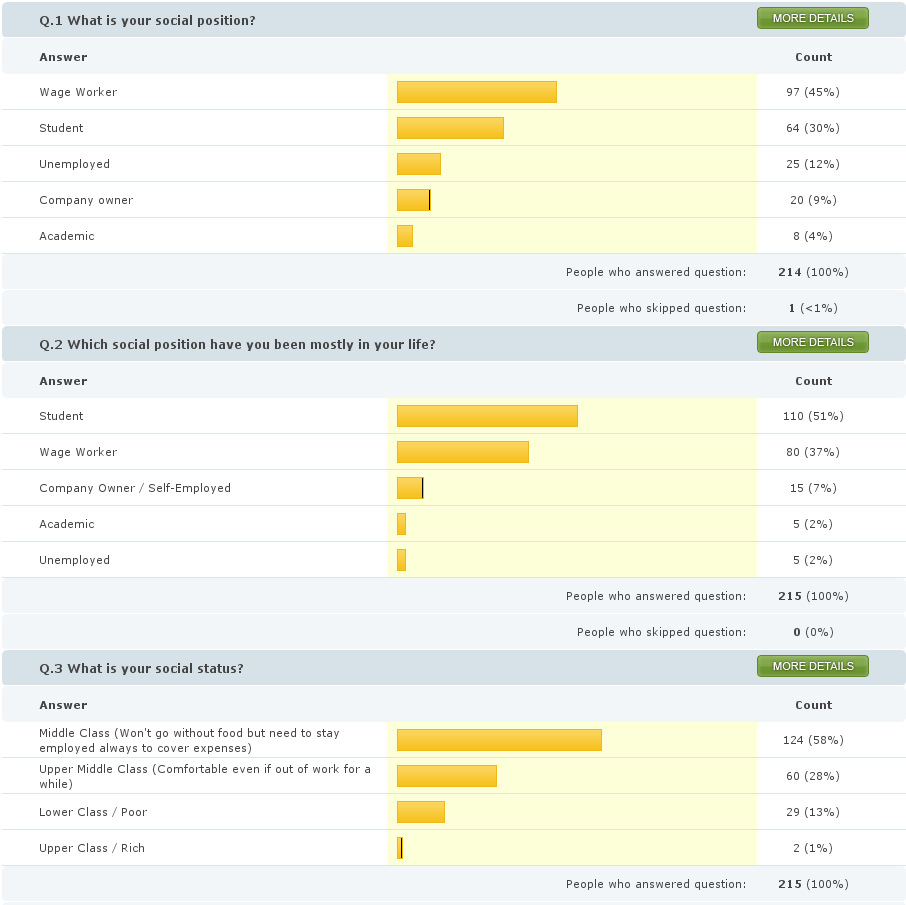
Individualist Anarchist social statusCompared to the overall Social Status, the Individualists seem to have a higher percentage of Company Owners and Academics and lower wage workers and unemployed but not excessively so. Unfortunately I believe that the question I asked on the social status were not enough to point out more fine differences that I think would have been useful. For example, I would be quite interested to see in which sector they are wage workers at as there is a big difference in the environment between an sysadmin wage-worker and a carpenter. This is certainly something for the next survey.

On the social status, it’s interesting that they have a higher percentage of people who consider themselves to be on the lower class.I wonder what kind of connection there is here.

Social Anarchists

These were the greatest group taking part in the survey, only late in the game overcoming the individualists. Interestingly, most of them seemed to start from their current position which makes me wonder what kind of upbringing they had and how their early environment affected their life. Did they get raised by LibSoc parents or did they just happen to be in a tolerant neighborhood? These are certainly questions that I will try to include in my next version of the survey.

Social Anarchists Orientation

As expected, Social Anarchists came mostly from the State Socialism side, following the libertarian socialist pull. Still, there were still quite a bunch of them that identified as propertarians for most of their life. Certainly, It must have been quite a trip from someone to move from stateless capitalism to communism or syndicalism.

Social Anarchist movement

Finally, there were also quite a few who consider equality and liberty to be on a scale rather than complementary to each other. While I can understand that from individualists, I can’t grasp it from socials so I would be interested to know some perspectives on this.

On the Social Status of the Social Anarchists, the result were more of what was expected.

Social Anarchist social statusThere is a far stronger presence of the working class which points nicely to the idea that wage-slavery radicalizes people to a degree. However while the percentage of wage-workers increased slightly, it was the student percentage that took a big jump. It seems that most of the Social Anarchists are or have mostly been still in education which can point us to two possibilities which of course don’t exclude each other. 1) Schools, colleges and universities can be a powerful breeding ground for socialism. Of course it’s difficult to figure out which is the correlation, which is why I think I should be requesting the ages of people in the future as well. 2) Social Anarchists might be as a rule younger and less experienced in life.  This is of course not necessarily bad as it’s most likely that wage-slavery will radicalize them even more, however it might also serve as a platform for other schools of thought to shallowly renounce us as immature or somesuch.

As for the social position, the Social Anarchists are as a group at the lowest rungs of the social ladder and we did not manage to have any of the rich within our ranks. Still I believe a greater sample would be more telling here.

Finally, I’m going to take a look at the two other camps of survey takers as a more generalized group or Left vs  Right so as to save some time. Of course you’ll be be getting the data yourselves so you can take a look yourself if you wish.

The Right (Minarchist & Stateless Capitalism)

There was quite a large number of such taking part in the survey, almost 1/4 of the total number of participants which tells a bit about my audience (hi guys & gals!) and the political consistency of /r/anarchism. Between them, their numbers were almost split in half.

The Right's Political Orientation

While many of those two groups either started from their respective positions or moved between them, there were a few that came from more egalitarian positions. I would be especially interested to see what convinced LibSocs to turn propertarian.

As for the choice between equality and liberty, the results are not surprising although I’m surprised about those who believe  that liberty requires equality. Since Capitalism is always a system which breeds inequality since it present the capacity for accumulation (indeed, it depends upon it), how can you both believe in such an idea but also support the Capitalist mode of production? I think that most who selected this option, perhaps were confused on either their choice of orientation or their choice in this question. Still, if someone consciously selected those two options, I’d like to hear the perspective behind this.

On the social status, the Liberals also have its largest percentage in wage-slavery but here it makes even more sense to know which sector dominates. I can’t get it out of my head that most will be in the Computer Industry.

The Right's social statusThe Liberals generally also seem to have been mostly students which also points to the possibility that intellectual pursuits are also conductive to liberalism. This makes me believe that I should also be inquiring on possibly both the sector one is studying in and also if the sector one currently works is the same one they’ve studied. I wonder is there is a correlation between liberalist feelings and someone managing to find work in their chosen field.

Finally the social status shows a marked move towards the upper strata. While they do not have any rich amongst them, both the middle and lower class percentages have dropped while the Upper-Middle class has increased by 8%.

The Left (Social Democrats and State Socialists)

First I’d like to say that I think I may have not been clear enough on the choices here (Curse you skewed US terminology). By “Social Democrats” I meant what the US Republicans call a “Liberal” while with “State Socialist” I mean mostly the variants of Marxist-Leninism which depend on the existence of a state to (temporarily) sustain the revolution/socialism. This might have been clear for governmental communists and the like but it might have confused Trotskyists. I had someone write to me that he didn’t know what to choose as a Marxist-Leninist so obviously this needs more work. Ideas on this appreciated.

Now on to the stats. As expected from being in the Anarchist subreddit, there were not a lot of Statists around so the sample if very small even between them.

The Left's political OrientationIt seems that isn’t extensive change in their viewpoints really but I was again surprised at how many people selected that you can’t have equality without freedom. If this is your viewpoint, then why do you support the existence of a state which is a profoundly authoritarian institution? Personally I expected far more people to select the “Balance” option in this case.

On the social status, things seem more or less standard. More collection on workers and students but greater concentration in the middle class. Unfortunately with such a small sample, it’s difficult to make a lot of conclusions as even the 1 rich person shows as a whole 4% of the total.

Epilogue

So that was it for now. I hope you’ve found the results interesting and my analysis insightful and of course, I will work on improving it more so that some more interesting information might be gleaned. At the moment, these are the kind of questions I’m thinking of adding.

  • Job or Study Sector.
  • Family type.
  • Early life environment.
  • Change question on “Which social position have you been mostly in your life” to “Which social position have you been mostly in your adult life”
  • Age.
  • Sex.
  • Private Property or Possession?
  • Political Compass quadrant.
  • Do you work on the sector you’ve studied?
  • Options for “co-op” and “Boss” social positions.
  • Labour theory of Value, Marginalism or some synthesis of the two?
  • School of Economics (Neoclassical, Austrian, Marxian etc)

I would really appreciate feedback and ideas of course. Especially on the questions you would like to see and how the survey should be paced.

There has been quite a lot of feedback from people who took the survey as well, some giving me some good ideas while others explaining what confused them. Below I’ll respond to some of them and you’ll be able to see the rest yourselves in the full export.

Feedback

Each quote represents a different submitter.

Attitudes towards different things (how valuable are things – things are more valuable to the poor; attitudes to poverty verses excess); social class growing up verses social class held now.

I’ve already included this as a question for the future and comparing those two will certainly be interesting. It might also point out how much a perspective changes as one grows up.

I also like the idea of seeing one’s attitude towards excess or luxury. I need to think how to phrase this though.

Ask more specific ideas on social issues, and methods of organization. For instance, if someone identifies as a social democrat yet, constantly agrees with Libertarian socialist ideas, it would seem they may not know what either term means.

I think that is too detailed for this survey. I’ll add however the Political Compass as an option and ask people to figure and submit on which quadrant they belong.

The options for “political orientation” are terrible, I don’t really fit within any of them.

Although I’ve added the general groupings as I see them, it’s likely that either you understand them differently or you think of yourself as something completely different. If any of you felt this way, please let me know what you would like to see (keep in mind that it needs to be something generic that a sufficient large sample might select) or how you identify yourself.

I’ve been a student and a wage worker since I could legally work, your questions need to have more options to choose from

You mean like an option for someone to choose worker & student together? Hmm. Perhaps I should make this a multiple choice vote? So that someone might choose Student + Wage Worker or Academic + Wage Worker.

Ask about politics and class of parents. Ask about type of occupation (management, finance, health care, etc). Ask about where they’ve lived.

Very good idea. Already added.

Religiousness — religious, deist, agnostic, atheist, anti-theist, etc.

Although interesting I do not know how relevant it is. What does everyone think?

What attracted you to your political point of view?

What information or insight lead you to your current political orientation?

I’m thinking of adding such open-ended questions, but they will have to be inputed as text instead of multiple choice, which will mean it will require manual reading and more time (and thus possibility to cancel the survey) on behalf of the survey taker. I may add it as an optional field and try to analyze it for general trends.

I mainly identify with the Green party philosophy, and was not sure which of your categories most closely represented it. I came to political awakening from an environmental/anti-nuclear path, and expanded it to anti-imperialism and disgust with the corporate plutocracy we have in the U.S. I think questions or an expanded answer set to cover those concepts would be useful.

I never even thought of this path. No idea how common it is but it looks to me that the environmental path closely relates to the egalitarianism path (ie, why do we need to protect the environment? To sustain general human life). Will think about this.

[…]So, while I may have said I’m a social anarchist, I was leaving out a lot of important information. I think it would be worthwhile to add questions about specific overlaps and compatibility between ideologies. Questions about the role of government (as a protector of rights, as a mutual-aid organization, as a leader, etc.), about private property, personal property, and common property (e.g. which one should be the predominant kind of property? Should any of them be removed from society?) and other items which make the ideologies what they are should be asked. Then, there could be a multiple-choice for which ideologies you could support, if they had the ability to replace the existing political and economic system.

This is certainly interesting and I’ve already decided to add some questions of this extent as well. Will need to think how many others I can cram into a multiple-question.

I suggest attempting to make a clear distinction between advocates of big government and advocates of *this* big government.

Hmm, how many such advocates are there? AFAIK both conservatives and social democrats always push governments towards an idealized status. I don’t think many are happy with the current one. Furthermore, since this is a test that I mostly target at Anarchists, I think most will simply skip this question.

– The political choices are very US-focused.

This is a weird feedback. How do you mean?

Consider adding “I don’t know” as a possible answer.

To some questions, that defeats their purpose. I am considering adding “Apolitical” though, although I guess such would simply not take the survey in the first place?

Asking about labels is not necessarily a good idea. That is, people can call themselves whatever they want but not really have a clue as to what that entails.

True, but for an amateur survey I do not have much choice. Hopefully, the addition of the Political Compass might help.

Asterisks exist for some questions without the footnote that should be there.

There are more types of Conservatives than you allow in your questions. I’m a Libertarian Conservative, not a Libertarian Socialist, but that’s not an option in your poll.

Asterisks denote mandatory questions, not footnotes.

As for Conservatives, I thought about adding such an option but I’m not certain what their significant difference from Liberals and Social Democrats is. I have even less an idea what a Libertarian Conservative is.

Also, the question about recent change in ideology should be modified. Recent change is subjective, so I’m not really sure how to answer. You should either simply ask if I have changed, and if so, what I was before, or you should ask if I’ve changed, and then, if so, how long ago did I change?

Hmm, yes, this does sound a bit more clear. Other opinions?

Have definition links embedded within the political assignments. ie, define libertarian socialist, etc.

Not certain if that is possible but it sounds like a good idea. Wikipedia?

I once postulated that you might be able to tell the difference between a republican and a democrat using functional MRI. Let me explain.

In this model, democrats are those who primarily see the world in terms of cooperation and republicans see it primarily in terms of competition. Of course, each of us knows that many parts of the world work according to each model, but it wouldn’t surprise me to learn that one couldn’t easily classify people by their predilection to presume that most of the world should be viewed as either one or the other.

“Cooperation or Competition” does not sound like a bad question. I think I’ll add it.

I started out as state soc leaning at ansoc, converted to the Libertarian Party, spun into ancap, and then found myself a libsoc… this quiz doesn’t allow me to say how crooked my path has been!

You’re killing me here 🙂 But I think you’re such a small minority in your political changes that it wouldn’t make much of a difference if you answered it as an approximation.

Data

Phew, so this is the end. I hope you’ve all enjoyed this analysis and I hope I’ll see you all in version 2 of this survey (no ETA yet). Below you’ll find a link to the raw exported data I’ve pulled today with which you can play in a spreadsheet. I release all of it under the same CC licence as the rest of this site so knock yourself out and just let me know if you write about it so I can link to you.

Raw Data: CSV, XML

Cheers!

Reblog this post [with Zemanta]