First impressions on Star Wars: The Old Republic – Not impressed.

I’ve managed to play SWTOR for a few hours yesterday, and these are my impressions.

PGWTOR 2011

So yesterday night, I’ve had the opportunity to try the upcoming Star Wars: The Old Republic during its open/stress test beta weekend, so I might as well write my impressions of it.

First I want to say that from everything I know about it, I was not planning to play SWTOR. The reason for this is that the game, to me, frankly seems like a reskin of WoW, circa 2005. Few classes and races, holy trinity setup, not particularly innovating gameplay, cookie-cutter quests etc. The few videos I’d seen about it, made it seem like nothing particularly exciting, unless one was a hardcore Star Wars or Bioware fanboy.

Don’t get me wrong, I like the Star Wars universe quite a lot (albeit, I’d love if G.Lucas stopped messing with it, and let some people with a more realistic understanding of ethics and human motivation take over) and I’m still a Bioware fan, but WoW couldn’t keep my attention for more than 3 months (and that was pushing it) and thus I didn’t expect such a similar game to do any better. Also compared to other games like Guild Wars 2, which really seem to be doing a lot of innovative steps at a far lower cost (i.e. no subscription), I just didn’t see why I should bother.

That disclaimer out of the way, let me give you my impression of the various aspects of the beta.

Getting to the game.

I got my invitation, from the Bioware social site of all places. It came in a PM from the admin directly, and frankly, up until that point I never even bothered to try the beta out. But hey, I wouldn’t turn down a free demo of one of the largest games of the year. I’m guessing I got the PM because I had bothered to actually populate the Bioware social with my Dragon Age characters and the like and I was also currently replaying Dragon Age: Origins. I doubt I would have otherwise gotten a free invite. But perhaps I’m wrong and everyone registered there got one as well.

Downloading the game client was a bit of a headache as well, because for some strange reason, the installation program would crash if I had FRAPS running. It took a lot of search online and in the forums to figure this out. After I managed to get the client, came the very long download process, which went OK, barring an unexpected BSOD just as it had finished downloading, which I’m not sure was the cause of the downloading client, but anyway. Nevertheless, I still don’t get why they didn’t use EA’s Origin, which they rammed down our throat with Battlefield 3, but rather they used this standalone client, and thus yet another useless program to have on one’s PC.

As the open beta period was starting, I was hearing horror tales about hour-long queues, lag, crashes and so on, but to my surprise, everything went without a hitch. Europe had only half a dozen English servers and far too many German and French ones. No idea why this is the case, since everyone who doesn’t speak German or French is likely to go to the English ones. Nevertheless, even with so few English-speaking servers, the queuing times were very small. I managed to create characters in three different servers within an hour or so (I swapped servers due to miscommunication with Plutonick and some other friends I was supposed to play with). Still on the subreddit for SWTOR, I still see a lot of people complaining about the long queue times which I didn’t experience. The worst I had, was 25 minutes.

Character Creation

I won’t got into a lot of detail here, since you can find lengthy videos about this all over the internets. I’ll just mention the things that stood out to me.

Why are the larger body type men somewhere between overweight and ultra-beefy, while the larger body type women are simply displayed as (in structure) large and curvy, but still fairly slim/athletic type? What is it with game developers assuming that there are people who will play overweight men but not overweight women? Just give the option and let people choose for crying out loud.

I like the varied options for characters but I was disappointed when I found yet another game where I couldn’t play a long-haired guy. The best approximation I found for cyborgs was a fairly tame bob cut. So I went for the mohawk instead.

On the matter of hair, why don’t facial hair have their own slider for cyborgs but are rather tied in with either “hair” or “cybernetics”? Perhaps it is different for normal humans, but for cyborgs, I just couldn’t make what I wanted.

I still don’t get why in this day and age, a game thinks it’s a good idea to keep all starting character uniform rather than let them choose some preferred skills, abilities and clothes? Why is it so difficult as a smuggler to choose to be proficient with a blaster rifle, rather than a blaster pistol? Why do we all have to start with the same clothes? This is supposed to be a role-playing game goddamnit. As it was, the only differentiation between starting characters of each class, were body types primarily and faces secondary. And within the same body types, you might as well have had clones.

Playing

Disclaimer: I only played through the introduction area as I didn’t have enough time (since the beta was, as is common with these things, starting on US time. Yeah, America is the only place that counts obviously). As such, perhaps I’m missing how things improve considerably later but I’m not holding my breath.

The first area might just as well have been the clone vats. Dozens of identical-looking characters, doing the same quests, using the same skills, killing the same people. It was all fairly silly. I realize much of this was because of the beta and because everyone was new at the game, but the whole thing still was looking messy. Especially with everyone vying for the same enemies to kill and whatnot, even with the instancing that happens to separate all the people in the same area.

For someone who is looking for immersion, the whole area was really a blow to my suspension of disbelief. There was nothing permanent. Any quest you did, reset a few seconds later for the next person. I blew up a communications tower and it was pristine a few seconds later, enemies just popped into existence 20 seconds after you killed them and a horde of newbies, wearing the same clothes and wielding the same weapons, was running through an area that was supposed to be controlled by the enemy.

It also still left you with very little opportunity to choose your path. As a smuggler, my enemies were always the “Separatists”. Was there ever any option to start working towards joining them? To stay neutral? No, there’s a railroad quest-line with very little opportunity to avoid. The best you can do is select a light or dark answer at the end of some discussions, but effectively you still had always the same end result. Seriously, at some point I was offered a quest from, the main storyline, and I selected the option which very explicitly said “[Refuse Mission]”. I was expecting the classic Bioware nonsense which exited the dialogue and didn’t let you continue unless you talked to them again and accepted anyway, but surprisingly, I simply got the quest regardless of my choice. The main quests are very much a railroad and the side quests, (which you need to get in order to receive the necessary experience) are all very simple. Mostly go there and kill that, or go there and destroy 3 of these things, or go there, kill that guy and get this item. All very uninspired with their only benefit being the fully spoken dialogue.

That last part was really the only saving grace of the quests which were otherwise completely forgettable and superficial. You see, nothing that you do affects the world around you, and you do not really have much of a choice when doing them. It really felt too much like the way I felt when doing Borderlands quests. Just gather as many of them as you can, go to the area where they’re all concentrated and just do them one after another by the bucketful. I never really felt at all interested in most of what I was doing as I had almost no input as a role player. I had no option how to approach the scenario, no choice to avoid combat and very little choice on how to deal with the quests. Just bland Dark VS Light options (i.e. good vs Eeeeevil) which  sometimes manifested in you finishing the quest at a different quest giver than the original. The voice acting helped to draw you back to the quest, but it was only at the beginning or at the end of the quest line (with few exceptions) and thus, it was just not enough to make me care. It just helped me avoid skipping the dialogue altogether.

In this kind of game, I always try to play a character that is fairly outside the boring norms of good vs evil behaviour or lawful evil VS chaotic good. For example, two of my favourite archetypes I like to play is an Anarchist ((Direct action towards helping others, or let them help themselves, combined with actions which undermine established hierarchical authorities, such as armies, police, states and other kinds of oppression – i.e. closer to Chaotic Good in D&D terms but with a lot of fine details)) or an archetype I call “Benevolent Might Makes Right” ((A character who believes the weak should defer towards the strong (in power of arms) but that the strong have a moral responsibility to protect the weak who are under them. Usually I couple this with some underlying racism (not against human skin colour, but rather against other fantasy or sci-fi races) and xenophobia as well as a strong sense of honour, loyalty and respect for accepted authority. i.e. similar to Lawful Evil in D&D tems, but again, not exactly)). Both of these are imho closer to the nuanced ethics and ideology of many humans and it’s interesting to see how they interact in a very binary system of “Dark VS Light”. What happens is that there is rarely any acts or dialogue choices that are provided to me, fit within the character role I’ve selected. Very often I’m given three different options in a dialogue and end up saying to myself “Well, this character would never say any of these”, so I’m left to choose the out-of-character option that more approximates me. So that Anarchist archetype usually ends up coming off like a greedy opportunist with a good streak, while the Might makes Right Archetype sounds like a schizophrenic.

I digressed a bit above here, but this was to point why the quest lines of SWTOR and the dialogue left me unimpressed. The characters I like to roleplay cannot be done in this game of standard Bioware trinary morality (Good, Eeeevil or Greed), and the quests are generally uninspiring.

What I did like somewhat was the dialogue system when multiple player are involved, but I feel that this has so much untapped potential that they simply did not even consider. Why did they go for simply random rolls to see who speaks, which have no relation to who is a better talker or has more powerful personality? Why don’t we have skills pertaining to dialogue that can be utilized in these cases either in combination with the other players when trying to convince an NPC (and avoid combat for example) or against other players when trying to see which quest path you will take? Some mini game, based on skills and abilities between the speakers would be a great addition to a game so focused on dialogue. Unfortunately I can see why a fully voiced game would shy away from something like that, as it could theoretically increase exponentially the amount of spoken dialogue. But then again, that’s why I think that spoken dialogue can easily be a detriment in role-playing games as it severely limits available options.

On the graphical side, the game is good-looking but nothing particularly jaw dropping. Fortunately that meant my VGA could handle it, even though on the starting area, my FPS took a severe beating. Initially I thought it was because I had too high settings, but my FPS managed to creep up to the high 70s after I moved away for quests, so it seems to me that it had mostly to do with how many Player Characters were around my area.

A minor peeve was how the game prevented me from playing with my two Jedi friends which were apparently on a completely different planet. I understand that this can be amended after you reach level 10 and leave the intro portion, but it still annoyed that I couldn’t play with my friends, especially since the only guy I could play with, got bored with the game within a few hours and left me alone.

As for combat and general such gameplay – One word: Boring. Perhaps this was because I was still at the first levels, but I never felt any challenge, nor any need to actually strategize. It was simply a process of using my abilities one after the other as their cooldowns expired and my energy allowed. As a smuggler, the cover mechanic worked only half the time, as it was very often I would stand next to cover rocks or whatever, and the character would simply kneel rather than use them. I could however run behind them and kneel and then I would actually get the benefit of cover. I also don’t understand why I couldn’t take cover behind covers, or behind trees. If you actually hide behind a tree and use cover, rather than peek out and shoot, the game would tell you that you have no line of sight. As a result of this loss of opportunity, the level designers ended up spreading random barrels and chests on the rooms, simply to act as cover for people, where the corners would have sufficed much more believably.

I still don’t understand what is with their obsession with 3-man groups. Granted you still find the occasional solo beefy enemy, but usually it’s groups of 3 people standing around for you to kill, before they pop back into existence a few seconds later. It was fairly silly, and at some point Plutonick got killed by such a group of three when he went afk for 3 minutes and it ended up spawning on top of him, at an area we had just cleared. I don’t understand why we can have larger groups, as was the case with other Bioware games, thus forcing one to actually strategize with Area of Effect abilities, tactics in movement and cover (such as when being attacked from multiple sides) and so on. But no, usually just the usual boring 3 enemies waiting for passers-by, or a beefy single dude.

In closing

I’ll probably try to play it a bit more today and tomorrow and see if things improve at all outside the intro zones, but I’m not holding my breath. I’m also interested to see PvP, but I don’t think it will be anything to talk about.

After playing this beta, I’m sure I’ll be sticking with my original plan to completely bypass it and try Guild Wars 2 instead. The price for this game, is imho just not worth the lack of innovation and lackluster role-playing and story. The funny thing is that I would be perfectly willing to purchase this game if there wasn’t any subscription required, so that I could play it at my leisure with a few friends a few times per month or simply as single player. But this is definitely not something worth however much a monthly subscription will be.

A quote showing everything wrong with the liberal ideology

Some liberals just love to moralize against anyone not wasting their energies voting.

ATHENS, GREECE - OCTOBER 04:  Supporters of th...

Quoth redditor blue_delicious (in regards to using the occupy movement to shut down a major port)

This is idiotic. Just vote! If you want things to change, you need to work hard registering people to vote. Get people registered and run OWS endorsed candidates in Democratic primaries. If you start winning primaries against establishment Democrats, the rest of the Democrats will start listening.

Head, meet desk.

This is the most infuriating argument I see coming from liberals, and especially the headstrong ones who will say it with a moralizing and smug attitude. In the sense that if you don’t adhere to this principle, you’re immature and deserve what you get.

I’ve already pointed the past why voting is against our interests, so I won’t rehash my arguments but I will point out the sheer “insanity” ((In the classic definitional sense of doing the same thing over and over and expecting different results.)) of this sentiment. Liberal parties like the Democrats of the USA, or the PASOK of Greece and especially their more enthusiastic supporters have been arguing thus for decades now. That not only people need to vote, but that voting for minor parties is just as harmful. Rather, the only course of action is to try to merge your ideology into a larger party and try to affect their policies from within.

But how many times does this tactic needs to fail before they might start recognizing that it does not work? Using all your energy to simply promote a spokesperson into politics has such small returns that it’s essentially a waste of effort. So you got your OWS candidate into your democratic primaries. Now they need to be elected to run, thus more effort needs to be extended. A new candidate is almost impossible to be elected the first time, so the best you will hope for, is some small position in the government where they need to “prove” and “market” themselves until the next elections. So remember, don’t rock the boat in order to show how well your candidate maintains order and thus brings in more voters.

Immediately, you’ve set back the demands of the OWS movement by 4 years (at best), which might as well be an eternity. Not only will the OWS fury and passion have dissipated by the next elections (thus basically removing all the voting base of the OWS candidate) but your efforts will have achieved nothing at all, except put another pretty and convincing face in office. A person you have no idea will continue to support popular sentiments rather than simply play the game of politics like everyone else and thus get corrupted in no time flat.

The OWS movement, within a scant few months of simple occupations and direct action, is already shaking the world, as liberal as it already is. Just by the fact that it inspires, radicalizes and agitates people and thus goads the state machine to greater repression, which in turn radicalizes onlookers and fence sitters even more. And if anarchists and other autonomists manage to successfully agitate for more significant direct action, then more and more people will join, just because the improvements in their lives will be immediate. At the moment this is still an anarchist’s wet dream of course, but direct action movements have a proven record for snowball effects. It is precisely the reason why the state reaction is swift and brutal.

Using all your energy to mold such a movement into a toothless electioneering campaign is a waste and most likely fatal to it. But even if, against all odds, such a grass-roots movement manages to sustain itself for 4 years until the next elections (and the whole system hasn’t collapsed by then anyway), then you still have to fight to put your own candidate in office, at which point, you’re already playing by their rules and not yours. You will have lost all the autonomist support, and the best you can hope is that you can muster a campaign as big as Obama’s, despite a completely disillusioned voting base and a huge lobby on the other side running candidates with more history and corporate backing then you’ll ever get with your fresh and hostile-to-their interests OWS person.

It is very likely that you won’t get them elected the next time either, or the time after that. And by that time, OWS will be in the annals of history and your OWS candidate will be just another democrat with a grass-roots history. Kinda like Obama, and look how that turned out, where that was a liberal victory where “all the stars were right” so to speak.

And even if, and that’s a huge “if”, you manage to get a “radical candidate” (*snort*) elected, you still have no certainty they’ll do what they say, that the bureaucracy will let them, or that the right reaction won’t intervene and destabilize via right-wing populists (after all, you’ve now aligned yourself perfectly to the democrats, which makes them an easy target for teabaggers) and, if worse comes to worst, military intervention.

In short, following such misguided proposals, when you have a red-hot social movement behind you, is the absolute worst thing you could do. Not only is the chance to get someone radical actually elected immediately slim to none, not only is it unlikely they’ll achieve anything even if they manage to get elected, but worst of all, your movements momentum will simply be wasted on trying to achieve useless things in the far future, rather than actually improving things and therefore snowballing in the here and now.

Big university party. Riot police bring the fireworks

The new unelected government lost no time showing it means business.

So the Greek university asylum has finally ended, in practice, as well. 4 Days ago, the un-elected government of Papademos, backed up by Juntaist and far-right politicians decided to storm the Thessalonikian universities shortly after the demonstrations of the 17th November for the Polytechnic had ended. This was this unelected government’s first “Polytechnic anniversary”, so the symbolism is fairly blatant.

Then with the tanks, now with the banks.

You now know to express heavy repression on the anniversary of Alexis. Be prepared.

Athens Polytechnic, 14 to 17 November 1973: When 350 dreamer-adventurers created the biggest defeat of the postwar labour movement

The Polytechnic Occupation and Upring was a turning point in Greek history, but it’s something that every political entity wants to claim. Here is its untold history.

The below is a very thorough and interesting article on the Polytechnic occupation/uprising that was written by Gatouleas in Greek. It was so good that I decided to translate this to English so that more people may learn this important part of Greek anti-capitalist and freedom fighting history. Enjoy!


November 14, 1973

Black and White people of a large crowd of university students (primarily males) demonstrating in the streets.Rizospastis 13/11/2005 ((Greek Communist Party newspaper, literally translating to “Radical”))

The Polytechnic is surrounded by police and students are gathered in the courtyard throwing Seville oranges. In the global-student assembly of the Law school, the news is spread that there’s fighting at the Polytechnic the assembly decides to descend to the University.

Ergatiki Allillegyi 09/11/2011 ((“Εργατική Αλληλεγγύη” literally translates to “Worker’s Solidarity”. It’s a weekly anti-capitalist newspaper.))

A syndicalist of the Revolutionary Left from the Physics-Mathematics [course],  proposes to stop the assembly and make towards the Polytechnic.

Ergatiki Allillegyi 09/11/2011

The leaders of both Communist Parties, during the first day in the Polytechnic were shocked that policy was determined by the line of anti-capitalist Left. They decided to stay “kneading” the perspective of the “coordinated retreat.” Already since Wednesday evening, that has been their proposal. When defeated, they began to struggle against the “leftist slogans” such as “General Strike” and “Revolution people.” But the General Assemblies of schools organized within the Polytechnic isolate this perspective.

On the subject of the Athens Polytechnic uprising against the Junta in the November of ’73 there have been written and spoken thousands of words and stories. It is only to be expected that there’s a lot of “storytelling” for such a historical event.

I will attempt to outline a perspective that has been covered extensively for decades. You see, the “myth” of the Polytechnic has attempted to describe those three days as a pandemic, celebratory and peaceful uprising of the whole Greek people against a handful of ridiculous and isolated dictators who survived only thanks to force of arms and American aid. “Everyone” had taken up arms (peacefully, always!)… Pangalos had been assembling bombs in the Latin Quarter in the May of ’68 and Simitis was placing them in the streets of Athens. On the other hand, the current Minister of Citizen Protection Papoutsis, along with Laliotis and Damanaki had organized the “mass movement” and the “sidewalks”, so that millions of people could flock to demonstrations, sit-ins and strikes.

All countries create such myths. Here even Germany has created the “anti-Nazi” people during the period of 1939-1945 in order to whitewash the fascist history of the “democratic” generals and politicians of their postwar history. Could the Greek politicians do anything less?

A Black and White photo of students occupying the Polytechnic University standing in front of a Tram. A sign for "General Strike" is displayed.
The occupying students of the Athens Polytechnic

But the Left as well has taken actions to make people forget that what happened in November was a genuine uprising, forged within the communist, jacobist tradition…

Today’s Left has relegated “Revolt” to a museum piece. Like a weapon we pull out very rarely. So rarely in fact, that for KKE (Communist Party of Greece) 62 years have passed and there’s still “not ripe conditions”… Needless to say that the last time was “wrong” as well…

Thus, today’s legalistic Left has a few prerequisites it requires before a “Revolt” can happen.

  • The Capitalist system needs to be in a “Crisis.”
  • The political system of governance needs to be in discrepancy with the “people”. A crisis of representation.
  • There need to be favourable international conditions (in grass-root movement terms).
  • The “people”, the “movement” to lie in “orgasm”. Have strikes, demonstrations, occupations. happening and those increasing in quantity but also shape a “communist” consciousness. Of course, the numerical participation in these events must also be “global”… and growing constantly in an arithmetic (if not exponential) progression.
  • To have one (or many) mass parties, with thousands of experienced members, networked throughout Greece, in all work and social places.

Of course, all these must last a sufficient amount of time so that a sequence of political events is created to “tie” the yeast. If ALL these things happen simultaneously, then YES! Our honoured Left will decide to murmur “Revolution.”

Let us travel back in time then, 38 years ago, to see what kind of conditions existed to make the “Uprising” of the Polytechnic. Was the Polytechnic uprising the peak, the maturing of a wholly-populist movement against a staggering regime, or a social “explosion” which found ground to break through via the “madness” of some “irresponsible, adventurist leftists”?

Crisis or Stability in Global Capitalism?

Black & White picture of crying children fleeing in VietnamFor 30 years, there was a continuous development at a global level which, in tandem with the capitalist profits, pushed a lower-middle class into a consumerist orgasm. Cars, refrigerators, televisions in every home…. opening of university education to wider social strata, formation of a “social wage” through an expanded program of public investment. Capitalism “appeared” to be living in its best days.

But in the last two years, the glass was cracking…

The US was being humiliated in Vietnam. For the first time, a great power was “losing” from a “small”. The symbolism was too strong.

On the other hand, A financial crisis breaks out in 1973 that is considered the “worst since 1929”, while the Arab countries declare an embargo on the sale of oil. 1973 is considered now the landmark year for the reappearance of the “capitalist economic crisis” in political terminology. The so-called “oil crisis of ’73” caused chain reactions around the globe.

Surely all these affected the confidence of the fighters of the Left. The Crisis and collapse of the system was not of course like the current one, but the appearance of the first crack often triggers – through sheer enthusiasm – disproportionate explosions.

But lets look at the other parameters.

Greek Capitalism and the Political System.

A parade of the Greek Junta in what appears to be a stadium. The sign says "Calm, Work, National Security".

Greece was a great postwar economic miracle! Growth rates reached 10% per year (second locomotive in the world after Japan) ((Sixth issue of the tri-monthly Economic Inspection of OECD, December 1969)) and the state budgets were in surplus until the fall of the Junta.

In 1969 ((Yearly edition of OECD, 1969)) Greece has the highest per capita income among OECD member countries, the largest – after Japan – increase of indices of total and per capita gross domestic product in market prices, the lowest price increase of the consumer index.

In April of 1972 ((Monthy Edition of Main Economic Indicators)) the growth of industrial output reaches 10.5%, metallurgy 26.8% and chemical products 20.1%.

This economic growth had enabled the junta to “buy out” her social bloc. They spread the famous “sea-loans” to every middle-class, Housing loans for personal residence, farmer loans up to 100.000 drachmas (something like 200-300 thousand euros today), “investment” tourist loans ((Financial Scandals of the Greek Military Junta))… and almost all of these never repaid. It is because of this that you still hear now the classic “How nice we were during the Junta”, which are the memories of middle-class for the “easy money” of the Junta.

The “oil crisis” that erupted in the summer of ’73 pushed the oil price and thus the inflation from 2% to 15%. Surely it was a shock, but I doubt whether it severed the social bloc power of the Junta.

The most important problem was the European orientation of Greek capitalism. The prospect of joining the EU (Then EEC) imposed a parliamentary democratic façade and created a rift in the strategy of the Greek capital. It was not possible to get a new member without parliamentary and european elections and without a rudimentary political system. So by the end of 1972 begins a period of “tolerance” and preparation of the climate for a controlled transition into some kind of democracy… something like the status of Turkey. In the summer of ’73, the monarchy is repealed by “referendum” and Papadopoulos is proclaimed “President of the Republic”, while in September placing Markezinis as a “Prime Minister” who would arrange the “Free Elections.”

Surely this “crack” of democracy, played the role. Some sporadic meetings at universities, the first union strikes, but everything could be counted in the fingers of one hand. Whenever they escaped the propriety of the cop (such as the occupation of the Law school in the February of ’73), repression was swift and merciless.

So, at the national level as well, we notice the first post-war cracks of instability. Too little? Or too critical?

Before answering, let’s look at “our own” forces and hopefully draw a safer conclusion.

International Movement

Black & White picture of President Nixon of the USA shaking hands with Chairman Mao of China.
President Nixon is meeting Chairman Mao. Totalitarian "Communism" and Imperialist Capitalism shake hands.

In 1973 the international communist movement has received successive defeats in its attempt of “May ’68” to challenge the capitalist domination. All its strains had been thrashed.

Mother “communist” Russia had invaded Czechoslovakia (Today’s Czech Republic and Slovakia) in 1968 to suppress the process of democratization and sovereignty of the country, creating a strange “equivalent” to that of the U.S. in Vietnam.

But the other versions of the communist movement had no “beacon of optimism” to offer either.

The center-left eurocommunism of democratic reform of the state was crushed in the summer of ’73 in Chile. The left-wing Allende fell dead from the dictatorship of General Pinochet, thus freezing a global solidarity movement to the Chilean people.

The Maoist movement had begun to receive huge credibility hits. Their “Great Helmsman” Mao had found a new “partner.” In early 1972, the U.S.A. President Nixon visits “communist” China and launches a new program of friendly relations. Yes! The president of the Vietnam war, the same from the Watergate scandal, is considered an “ally” of the “other” communist movement.

A Black & White photo of a Ulrike Meinhof in her youth, sitting in a couch looking towards the camera.
Ulrike Meinhof, part of the core of the defunct German Red Army Faction. A violent city guerilla with communist ideology.

Of course, the “grass-roots” [political movement] May of the French had been defeated in the same summer. The elections that president de Gaulle called had him re-elected with an overwhelming proportion over 50%. It was the first great lesson that if you don’t draw your own organizational strengths, you will always lose to your opponent…no matter how weak they are.

But even the city guerilla had received a hard blow. The arrest of Baader and Meinhof, i.e. the core of the German RAF (Red Army Faction) in 1972 put an implacable political dilemma in this concept. This followed the battle of the Olympic Games and the suppression of the Palestinian strike at the Israeli mission. Armed rebels seemed incredibly weak in front of the state machine.

All the hope that had been born in the ’60s, in Europe, America and the Third World national liberation movements seemed blocked. Each “proposal”, old or new, Stalinist – Trotskyist – Maoist – Guevarist – Eurocommunist – Autonomist, had suffered a crushing defeat.

The movement was entering a period of recuperation

Greek Movement

Things here are almost clear. The labour movement had been crushed in the coup of ’67. The entire reconstruction effort of the late ’60s, all the heroic battles of the Julians of ’56 had been dissolved by the military regime of Papadopoulos.

Black & White picture of a students on top of a building, holding a composite sign which spells "Freedom" in greek.
Occupying students of the Law University, shout "Freedom" from the rooftop, 9 months before Polytechnic Uprising.

The unions dissolved or became narks. Police had official branches of “labour” and “student” in order to monitor every suspicion of collective action. Even a gathering for a cultural association had its official snitch.

But the “whip” is never enough to sustain a regime. It also needs its “carrot”; it needs the arrangement of a social bloc – other than the capitalists – which will support it, and the rest of the overwhelming majority to “tolerate” it at least.

The economic growth that prevailed in Greece allowed the regime to buy-out the middle classes. This caused a corresponding ideology of happiness and anticipation for an even better tomorrow.

The exceptions of some heroic strikes cannot hide this reality. The “epicness” of the two 48-hour general strikes, the continuous 24-hour ones, the union continuous strikes and the occupations of public buildings that are happening today, did not occur even in the wildest wet dreams of the most drunken dreamer rebel during the seven years of the Junta.

The attempt to occupy the Law school 9 months ago, was crushed at birth, and (logically) a repeat of it would act as a disincentive. Is that not so?

Parties and organizations of the Left.

A Black & White Picture of a Man in handcuffs, surrounded by police and politicians of the Greek Junta
Alekos Panagoulis tried to execute the dictator Papadopoulos in 1968, but failed and was arrested.

Here is the absolute ZERO! Everything was illegal and KKE had split in 1968. The dissolution was absolute! A few members and without any kind of infrastructure. A telling example is given to us by Nikos Karras ((Interview in the Magazine “The Commenter” 60-61)), a leading member of KKE and later KKE Interior (The epochal version of the SYRIZA party):

…I was telling my wife that the whole point was to get in contact with Mina, since we had foreseen to erect an illegal infrastructure in case of dictatorship. When, thus, we met with Mpampis ((Mpampis Drakopoulos, another leading member and future president of the KKE, Interior)) down at the beach, I asked: ‘Have you found Mina?’ ‘I found her.’ ‘Finally’ I say ‘let us prepare something.’ ‘Nah’ he answers, ‘she has nothing.’ ‘Nothing? Not even a polygraph?’ ‘Not a polygraph nor anything else!’

The reconstruction effort is slow and laborious. They have to overcome all the problem of lawlessness, and their political unreliability. The inability of the Left to resist the coup on one hand, and the economic and political stability of the regime on the other, put very large problems in front of the non-branded fighters… the others were either abroad, in prison, or exiled to barren islands.

Tragic finale and brilliant start

Typically, the Polytechnic was a “defeat” for the labour movement. And how could it be otherwise? With all these negative conditions around it, the uprising not only failed to achieve its stated objectives (the fall of the Junta, removal of NATO bases, etc.) but was repressed violently with dozens of dead. Even the rudimentary democratic rights and concessions that were being negotiated by the government, went on hold.

A Black & White photo of tanks rolling in the streets of Greece
Suppression of the Uprising. Tanks marching outside Polytechnic.

Neither did it usher in the Parliamentary Republic, as wrongly written by Greek mythology. That had already been initiated “from above” for capital needed a European profile on its way to the EU.

So, if these unfavourable circumstances were leading with mathematical precision towards a crash, was perhaps the uprising a “mistake”?

Not so in fact! The Polytechnic ushered in the Metapolitefsi (Regime Change)!  In other words, the entrance of the mass movement as a political factor. The workers, the students, the communist movement, was articulating against the aspirations of the bosses. The building of the trade unions, the leftist parties, civil rights are not won by Parliamentarism, but rather by the Communist labour movement. If in doubt, see the Patriot Act in the U.S.A., the civil rights in Turkey, and whether “Parliamentarism” has prevented the operations against house squatting in northern European countries.

The dead of the Polytechnic cancelled any chance of social consensus with the government. They brought to the fore, the social and political polarization. They redefined the boundaries of right-left… in our own terms.

Never again has a “defeat” in the greek labour movement been so promising, like that of the Polytechnic.

The legacy of left legalism – reformism

A newspaper clip of the time
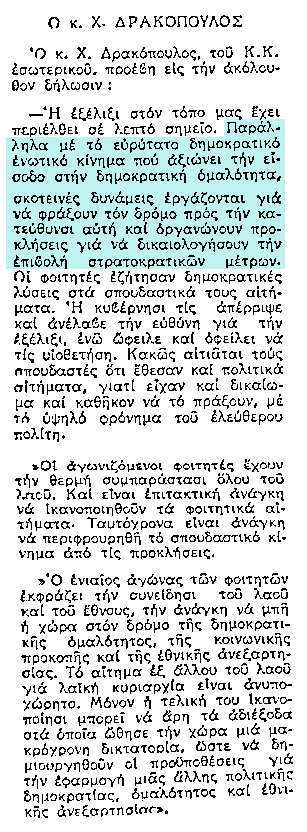
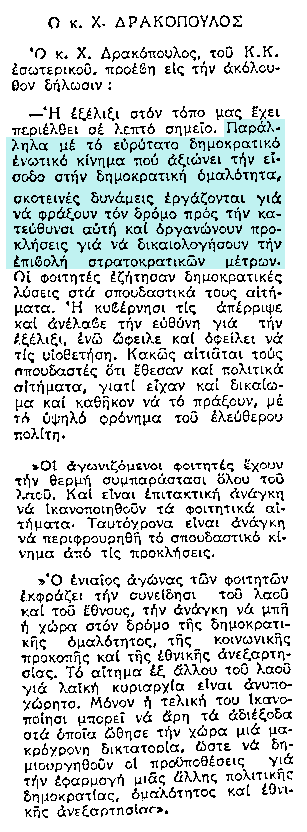
A newspaper clip from the condemnation coming from a communist party speaker. The highlighted part reads "In parallel with the larger democratic unifying movement which promotes the entrance into democratic normality, dark forces are working to block the road to that direction and organize challenges so that the imposition of military measures are justified"

Rereading thus, the context of historical events 38 years later, one might say that there was not a single prerequisite for insurrection. Both against the Junta, let alone capitalism.

In an international and Greek level, capitalism did recover as the winner, the crisis had not begun to unfold, while the subjective forces of the labour and communist movement are fragmented and defeated, with the middle classes hostile to anti-capitalist points of view.

This explains the shouts of disapproval against the Polytechnic uprising, by the Communist Party (KKE) and KKE Internal (the SYRIZA of the times). Having read “correctly” the criteria that are ruminated, even today, by the majority of the left, the uprising was an “adventurist” move, without vision, without organization, without preparation, without social alliances, which put at risk the entire labour movement.

Even a year after the uprising, the two Communist Parties of the time were strongly condemning the Occupation of ’73 as a leftist setback of the movement. After the fall of the  junta they changed their tune and attempted to expunge from the Polytechnic of ’73, the element of the uprising as coming from an organized intervention of Revolutionaries – Communists.

A newspaper clip from the Panspoudastiki newspaper
An "announcement-answer" clip from the Panspoudastiki newspaper. February '74

The Communist Party of Greece wrote ((Panspoudastiki No 8, February 1974)) that the invasion of 350 provocateurs in the Polytechnic during November, was a minority act by Anarchists in order to set up a caricature revolt and provide an excuse to restore martial law.

The Communist Party, Internal of Drakopoulos  and Kyrkos, believed that “The Athens Polytechnic took us 10 years backwards” ((Nikos Karras – Interview in the Magazine “The Commenter” 60-61)) and condemned the “challenges that provide an alibi for the imposition of military measures.” ((Newspaper Macedonia, 17-11-1973))

Today’s Left is a true child of the despondent legalists of the KKE and the eurocommunist KKE Internal. Those rehashing the terms and conditions, those who “condemn” the extremists of provocateur elements which endanger the labour movement, do not belong to the generation of the uprising, but to that of compromise and reformism.

 The inheritance of the “350 Provocateurs”

After we’ve described the adverse objective and subjective conditions, it would be good to try to reach the “paste” of the instigators of the uprising. What the hell were they thinking?

Because the occupation of the Polytechnic was an organizationally set move coming from the, then, Revolutionary Left. The fighters of the Revolutionary Left chose it after the “defeat” of the Law school. The NPR was at a main road and could not be cut off by police such as the building of the Law school in Solonos. The PaSoK-KKE-SYRIZA were caught napping, the occupation happened, and the Junta attempted to act a “Democracy”. The occupation started becoming a mass phenomenon and the military suppression came 3 days later to dissolve an under-construction centre of revolutionary overthrow.

I suspect that the instigators of the occupation had any of the three characteristics

  • They made a wrong analysis of the times. They had not read the retreat of the movement and thus estimated a pre-revolutionary period.
  • They were inexperienced uber-revolutionaries. They had not imagined the dynamics that would arise from the occupation of the Polytechnic, nor the rabid response of the state. They might have considered it even as a “preparatory stage.”
  • They were subjectivists. They put their own volition over the objective circumstances.

Their most important characteristic however, was that they saw themselves as a Subject of developments.

A Black & White picture of a german revolutionary paphletThey were followers of a great tradition of the labour movement, which recognizes the need for a separate political centre of Revolutionaries. That sees Communism, not as education, enlightenment of the “ignorant by the enlightened leadership”, but rather as a Movement within the Movement.

Obviously I’m not advocating that wrong estimates and uber-revolutionarism are “recipes for success.” On the contrary! These weaknesses are what lost the wager for the Revolutionary Left and thus failed to “inherit” the uprising, to continue into winning a second attempt.

But they left a legacy that is almost lost in oblivion… That of revolutionary determination and Subjectivism. That which tries to find the weakest spots in its opponent and bit as hard as it can… with whatever strength it has. That which opposes Objectivism (([Translator Note: Not the Randian Kind])), the Long Encirclement of Capitalism, and the Ripe Fruit.  That which does not consider revolution to be an exact mathematical praxis, but rather a chaotic system of equations where a Revolutionary Subject can change the course of history.

The legacy which makes people consider themselves as organizers and battering rams at the same time! And not a self-loathing analyst and “expressor” of social strata.

This is the required tradition for a Labour Movement which seeks a new proposal against the capitalist hell.

And a sci-fi “historic” test…

There is a simple way for each of us to recognise in which tradition we belong… and that may help us today.

Let us imagine that we possess a communist time-machine. A cocoon which teleports us to the past.

Suppose you are transferred as a student in the Law school’s meeting in the morning of the 14th of November 1973, and you can now vote.

You know what is about to happen, and the only thing you have, is your own skin. I am sure you will try to make the Junta fall, you will give everything for the Left and the movement.

However…

Would you have voted AGAINST the occupation, so that the uprising can be prepared better? To take better advantage of any democratic openings? To grow your organization? Would you attempt to convince on the 15th to leave peacefully and in form, “before dissolving”? Perhaps on the 16th you would beg your comrades not to give the state a justification to send in the tanks?

Or would you vote FOR and give a utopian struggle  to overthrow the Junta within 3 days, regardless of all the “objectively” difficult conditions you’re having and the repression you KNOW is going to come? Would you push furiously to take advantage of every minute of class struggle, determined for everything? Ready to continue with an ever greater momentum on the 18th for the next round?

In the first case, you do well to lie within the chains of PAME-KKE or bargain for ministries with CenterLeft-Kouvelis

In the latter, welcome to the most magical and utopian history written in the 21st century…

In the colours and music of the Revolution.


A Black & White picture oh a hand graspind a small black flag, rising from an erupting steet.

What are the ethics of Piracy?

Is it ethically wrong to pirate games? I refute 4 common arguments for this.

So, the moderators of /r/gaming in reddit have decided to make a grandstand against Piracy and as these things go, a big discussion spawned up around this announcement. I jumped in as well, and that turned out into a long thread about the ethics of pirating games. So I decided to expand and clarify my opinion on that point.

If you’ve been reading this blog for a while, you’re most likely already familiar with my general opinion on piracy (Long story short: I’m strongly supportive of it.). It is for this reason that I cannot stand silent when the usual moralizing against pirates crops up (with alarming frequency) on reddit.

There are a few common arguments for the moral condemnation of digital piracy which I’ll attempt to refute in this post.

Nobody deserves to experience a game or other intellectual property against its creator’s wishes.

The argument here relies on the concept that whoever creates a game gets to choose who is allowed to experience it arbitrarily. At the most basic level, it tries to shoehorn an intangible or infinite good, such as an idea or a specific expression of an idea, into the natural limitations of a tangible or finite good, such as, say, furniture.

This principle – that the creator decides who gets to use it – comes as almost a law of nature for tangible goods because it is built-in the concept of trade required before any use by another person can happen. In other words, before I can experience sitting in a chair, I have to acquire it from the chair’s creator which implies an agreement. The same is true for services rendered, which might be intangible as well, but are still tied to a finite good which is time spent by the one performing the service. So if I want to experience someone playing music to me, I need to have an agreement from them doing so.

The only reason why an exchange is happening in most of these situations, is because this is the norm for distribution we use in our current economic system and because the experiencing of these goods or services is a zero-sum. This means that if two people want to use the same goods or services, an exchange needs to happen to keep things fair and civil, or another socioeconomic system needs to be in effect, where sharing and communal ownership is an accepted scenario. For bad or for worse, the latter option is dismissed and outright, and thus by necessity market exchange become the only good scenario. To put it simply: If you want to acquire a good or service, the only moral option is to compensate its current owner (usually the creator) for it.

Given that for most people, this is the only moral way to acquire goods, it is not difficult to see why it’s immediately juxtaposed on something which does not need it: intangible and infinite goods.

In other words, the above moral condemnation relies in internalized moral values coming from an upbringing within a market system such as Capitalism where all other options for distribution are marginalized, dismissed and demonized. When market agreement for the acquisition of goods and services is all you know as morally acceptable, it is not hard to see why the acquisition of “digital goods” will be considered as immoral is such a market agreement did not occur beforehand.

It is because of this that for many people, even those who pirate themselves, it feels wrong to see people acquiring games without paying for them in some way. It is this feeling of moral condemnation, from which I believe most people start  and proceed to claim that it’s wrong for someone to experience (“acquire” ) digital goods without the agreement of its owner. But this moral sentiment has no basis because the same laws of distribution do no apply. There is no zero-sum game between current owner and anyone else. If anything, the concept of ownership itself loses its meaning when talking about intangible goods and we start talking about replication of goods, rather than exchange.

It is for these reasons that I cannot simply accept the above ethical proposition, which relies on nothing else than societal conditioning. However, most of the time, if you ask the person proposing the above “why”,  then a different justification may be presented.

Game developers expend tens, if not hundreds, of millions of dollars to create games. They deserve to be rewarded for their efforts and costs.

While I agree that someone who creates something very popular should be rewarded accordingly by society, the argument that someone doing something costly (in time or money) deserves to be compensated does not convince. I could bake very expensive mud pies but it would still not entitle me to money for them. If you’re going to support a market system, the whole point is to give people a reason to buy your product or hire your services. One cannot support a market system in one hand, and on the other claim that someone is entitled to reward for effort and cost extended

The main problem here is not that people are pirating games, but rather that the companies making them are still confused about what they are really selling. Copyright law allows someone to pretend that an infinite good is finite, by artificially limiting its supply. It is for this reason that game companies still create games with the misguided assumption that they are creating commodities, rather than services. This is a flawed business model which is built on top of a very flawed institution: Copyrights.

But copyright is realistically ((Theoretically it’s a law created to promote progress and the arts, but multiple studies and the actual number of modern creative works prove that it is not only unnecessary for this purpose, but actively harmful)) a law created and enforced specifically to support a specific business model: That of selling books in a technological level where printing books is not affordable for the everyday consumer.

So now we have multibillion dollar industries, built around a business model, relying on a law for a different technological era, applied on things it’s not meant to apply to (digital goods). There is no valid reason why any informed consumer should respect such a business model – and this is why the latest generations simply don’t.

A developer of an expensive game, absolutely deserves to be rewarded if their game is popular, but they do not deserve to rely on an obsolete business model, just so that they can achieve hyper-profits; because that’s what it boils down to. Business models relying on artificial state-granted monopolies such as copyrights are by design far more profitable than business models made with the digital age in mind. And there’s no doubt about it that the latter can be profitable as well. Any look at the MMORPG industry as well as the indie game industry will show that the latest trends are for free-to-play games which monetize their audience through other methods.

These may still be relying on copyrights to a larger or smaller extent, but those proto-business models are still evolving and it’s very likely that forms will be found through which one will be able to monetize even free software games.

If a developer wants to give their game away for free, more power to them, but if they want to sell it at 59.99$ a pop, we have to respect that.

This is a variation of the very first argument and relies on the same assumption: That the owner (usually the creator) gets to decide arbitrarily if and how we are to experience their product. I’ve already explained why this is an emotional argument and why it does not apply to infinite and intangible goods so I will not repeat myself.

I will however point the borderline schizophrenic way that this is applied to games (and attempted to be applied to other digital goods as well) where they want games to both be considered individual products, for the purpose of selling them to you as a package and at the same time want them to be considered services as well, for which you need to acquire a revocable license which you are not allowed to transfer to others.

In other words, the developers want to have their cake and eat it too. They pretend that the best part of tangible and finite goods (for their bottom line) apply, while requesting laws and moralizing against that the best parts of the same types of goods, so that the consumer cannot use them.

It is disappointing that opponents of piracy will gladly grant the creators of content the freedom to pretend whatever they wish, simply because they accept the above maxim. That the creator/owner gets to decide how you experience their goods.

But I see no reason why the creator/owner gets to decide which laws of nature apply.

If everyone got those games that costed millions to create for free, then the companies making them would stop.

I’ve dealt with this argument extensively in my analysis of the Economics of Piracy so I won’t go into detail. Suffice to say that this is a very flawed understanding of how content creation works within a supply & demand market economy. In short: if there is a demand, someone will find a way to make money fulfilling it.  If the previous business models fail to achieve this, then new business models will evolve to perform this task.

Consider this: 8 years ago, it was unthinkable that an MMO could function without monthly subscriptions. And yet, slowly and as the audience increased, MMOs have discovered that monthly subscriptions are less important than a large user base, and have slowly progressed towards a free-2-play model in order to attract more initial customers. The business plan has changed and now the demand is satisfied for high quality MMOs, while still allowing the companies behind them to make money.

Or take Team Fortress 2: In a day where most AAA games come out at full price with frequent and expensive DLC; TF2 has increased its profits tenfold by going completely free and providing all its (frequent) updates for free as well.

And these are only the beginning. It is completely false to say that if people could get the games for free, such games would not be made. What is true to say, is that the companies which refuse to change their business model to fit with the times and the advances in technology, will go down with them.

But it is not moral to respect the wishes of a company who wants to sustain itself on obsolete plans.

Quote of the Day: The Steve Jobs market relationship

No Messiahs here.

Steve Jobs

Quoth Girlcore

“steve jobs turned apple around by turning liberal humanism into a huge marketing gimmick and selling it to hipster college students. he disguised market relations as social relations and made dumb 20-somethings think that the role of seller/consumer is some kind of intimate social bond as long as the company has commercials that appeal to their generic liberalism. this is why a bunch of people are acting like when some CEO billionaire who sold them a product died it was like they lost a personal friend”

Truly, I was always amazed at the kind of rabid following that Apple has achieved and the borderline cult of personality that has formed around Steve Jobs. I can understand people blindly following leaders, but a billionaire CEO with a sad streak of (attempted) authoritarianism?

I shudder to think what would have happened were we to replace Microsoft with Apple. The top down absolute control they demand for their products, on software AND hardware and the way they abuse the patent and trademark system in order to stiffle competition would have choked the free software movement by locking down hardware control as much as possible, and going after people who sought to bypass it.

I have really no sympathy for the man. As much of an icon of our age as he was, his company’s business practices did and continue to do immense harm in our culture. The rabid following he and apple have for having shiny products and a strong marketing section, is really sad in my eyes.

Why are gamers obsessed with review scores?

Battlefield 3 fans are raging against reviews that gave the game just 9 out of 10. I explore possible reasons why.

BATTLEFIELD 3

Battlefield 3 is going live tomorrow and already the “Day 0 reviews” are hitting the net, and as is usual with these kind of things, the battlefield 3 fanbois are furious. Furious I tell you, that the game received only a…9 out of 10 on one review site which game Modern Warfare 2 a far better score back in the day.

Following that incident, there’s not only been quite a lot of flak thrown IGN’s way ((Disclaimer: I don’t have much love for IGN myself, for being a sold-out advertisement mouthpiece. This is an attitude I’ve had regardless of whether they are praising my favourite games or not. As a matter of fact, I would think that a 9/10 is very good, if I thought such numerical scales are a good way to rate games.)) but also a flood of review scores are hitting the front pages, celebrating the high score or denouncing the dirty rotten reviewer who dares to rate it lower than expected. Valid low points of the game, such as the campaign being far too trite, small and linear are trivialized (“BF3 was never about single player, why are you surprised”) and every high review score is upvoted to prominence.

The whole phenomenon is interesting to me because of how similar it is to behaviour of fans of sports teams who agonize for their placement in the league, for how many games they’ve won or lost and take it as an  almost personal insult when someone badmouths their team. And yet, video gamers tend to snub their nose at sports fans for their obsession with their teams, as if their own behaviour is better.

On the average however it isn’t. Time and again, reviewers not only get lambasted by the fans of a particular game when they rate it low, but there have been more than a few cases of threats and wishes of physical violence against such reviewers for doing such an unthinkable thing.

But reviews are generally directed at people who are undecided about a particular game, so why are those who are already convinced of its superiority upset about a low score or obsessed with achieving as many high scores as possible?

At a base level, I think this is because of the Illusion of Asymmetric Insight combined with Choice Supportive Bias. That is, the people already convinced of the quality or superiority of a particular game, either because they are long time fans, or because they have already put a significant portion of their disposable income towards it, tend to start thinking themselves in that group. When someone puts down their choice ((compared to their expectations that is, because giving a game a 9/10 instead of a 9.5/10 is not a big difference)) then the first explanation put forth for this event, is that the people doing it are in the out-group or stupid: They are biased, they are sold out, they are unprofessional and so on.

Thus if IGN rates the Battlefield 3 worse than Modern Warfare 2, then the most logical explanation is that they are playing for the another team, at which point the Illusion of Asymmetric Insight comes into play.

But further than this, we see a much greater obsession with scoring in reviews than almost everything else. In no other product will you see such praise or anger towards review scores from large publications, than you will see in video game circles. Sure, Android and iPhones, MS Windows and GNU/Linux, Vim and Emacs, they all get their own share of fanboi wars, but from what I’ve seen there’s just not this amount of bitterness created by such conflicts and when it happens, it’s usually because of the choice supportive bias such expensive gadgets create.

Now to be accurate, not all games create such a rabid protectionism in their followers. Games like Red Orchestra 2 for example, which are similar enough, never had such an extreme reaction to bad reviews. So there’s obviously some factors that drive up the fanboysim.

One of the most important ones I believe is that focus on multiplayer that a game has. The more multiplayer focused a game is, the more people you want to have playing it, so that you have a robust community with a lot of choices for the players. A bad review can cause people who are on the fence pass the game and thus reduce the community size, which will can indirectly impact the multiplayer experience of those who really like the game (i.e. nobody wants to find only empty servers). A good review on the other hand can make more people join the fun, and thus the incentive to promote and praise such reviews.

Incidentally, I’ve also seen the exact opposite result against games the majority didn’t like. A recent example is Brink, which for various reasons disappointed a lot of those expecting it. Personally I found the game great but in those initial days of its release, I found it practically impossible to find a positive review of it upvoted in reddit. Such articles were almost immediately downvoted and thus buried from eyesight, by those who felt they got burnt from the game. Why did so many people felt the need to prevent others from discovering a game they didn’t like? I’m guessing they thought they were preventing others from getting burnt as well, but could it also be that allowing the promotion of such a multiplayer game would in a sense “steal audience” from all the other multiplayer games?

The second reason I feel promotes fanboyism is when there’s active competition. Both Battlefield 3 and Modern Warfare 3 come out within weeks of each other. They are the most widely anticipated releases of the year and they compete for practically the same audience. Realistic looking modern warfare multiplayer FPS experience. There has always been a simmering comparison between these two, much like back in the time, there was comparison between Starcraft and Total Annihilation, even though they had significantly different playstyle. But the fact that both were Sci-Fi RTS that came out around the same time, gave rise to the inenvitable comparison between the two.

Today, in the eyes of many, the underdog that has been the Battlefield series, attempts to finally dethrone the leading champion that is the Call of Duty: Modern Warfare series. Many still enjoy both just as much, but the marketing force of EA certainly pushes the comparison in the eyes of the audience ((See for example how they close some of their trailers with a quote of “Beyond the Call”, which is a direct jab at the Call of Duty series)). So even if many players are prepared to enjoy both franchises, not only do the companies behind those games prefer a direct competition, but many of their fanboys see it this way as well, and will lose no opportunity to put down the opposition.

Which, unsurprisingly, is what a bad review becomes. The opposition. Treason.

Finally a lot has to do with the intended audience as well. The sheer popularity of those games and their target audience of teenage boys and young adult males means that those more impressed by the marketing and word of mouth, will also tend to be fairly impulsive and immature (Just take a look here and see how many references to male masturbation you can find). This is likely to exaggerate asymmetric insight and choice selection bias, thus further stoking flames against those badmouthing their newest favourite game.

I will admit, I’ve also noticed that I’ve fallen victim to a lot of the above biases. I too catch myself upvoting positive aspects of the game and downvoting mentions of negative. I check myself to avoid it, but it’s notoriously difficult to control one’s subconscious impulses. It is precisely because I see how much this drive to belong and support “my team” is affecting my behaviour, that I decided to write this post and explore the reasons behind it.

Personally I think review scores are irrelevant and that most major publications are sold out anyway, so there’s little reason to trust their reviews, whether those are negative or positive towards the game. I have a different idea on what constitutes a useful review in a findamentally subjective experience such as a video game, but that’s a subject for another day.

I own you

My wife-pwns me.

Today I leave you with another another lovely post by my equally lovely wife.


This is a good example for how deep you can maneuver youself into knee-deep crap, by trying to show how much better you are than others. The story happened in our summer vacation. The victim is my beloved husband, db0.

Dried oregano for culinary use.

Db0 holds up a small electric hand-held coffee shaking device, the wrong way around. “How does this work? Gruuaaaah!” (tries to do the Barbarian)
Me: “Hold it into the glass. Now turn your hand around.”
Db0: “Aaaah! Sometimes I wonder how things are so obvious. I’m having a silly phase: For you it was totally clear, but for me it just didn’t ‘click‘…”
Me: “Oooch! Mabe you’re just a bit slow this morning… my poor darling!”
DbO: “What are you already expecting me to say? Mmm?”
Me: “What?”
DbO: “The oregano!” (To explain what this means: I was standing right in front of the oregano bottle a few weeks ago, which was basically poking into my eye and still couldn’t see it, insisting that we didn’t have any, until he pointed out to me)
Me: “You know, you always remember the oregano story and remind me of it when you did something silly, and want to point out that it happens to me as well. I think you must have used this one story, like three or four times by now!”
DbO: “Ach, I’ve used it at least ten times by now!” (puffing his chest)
Me: “So you, Mr. ‘I-am-with-silly’, don’t understand that this one story had to be told several times, as compensation for your own stupidity, now? And you didn’t even ‘get it’ when I pointed it out to you, but rather proudly made it ten times? I’ve just owned you!”

In Germany we have a saying: “If you don’t know shit, just shut the fuck up” (Wenn du keine Ahnung hast, einfach mal Fresse halten). I think that applies nicely here 🙂


Db0 here. Story is true. I did self-pwn myself. To my defense however, I can never remember all the times she’s screwed up, so I always fell-back to the oregano story which was close to my memory. Oh well 🙂

Quote of the Day: Immortality

The internet makes our thoughts live forever.

Quoth happybadger

The time is 16:33 on 18 October, 2011 AD. In a fraction of a second after I click “save”, this comment will be readable by you- someone whom I have never met and who may be on the other side of a planet living in a country which I’ve only heard of from a Wikipedia article or brief mention on the BBC.

This comment will have travelled thousands of kilometres within a second of clicking save. Within minutes, it will be picked up by electronic spiders which comb the internet for new content and index it. Within an hour you should be able to google the first sentence of this paragraph and see my comment, within a day it should be on every search engine online.

If this comment goes viral, millions of people will be viewing it simultaneously and it will be rehosted many hundreds or thousands of times. You don’t know my name or anything about me, but you’ll have countless platforms to read the words I’ve written.

In a year, those same websites will still exist. The indexed passage will still exist. You can google the first sentence of this paragraph and find my comment. Within a decade every cell in my body will have recycled itself and I will effectively cease to exist as the same creature I am now, but these words will stay exactly as I wrote them. In under a century my cells will stop recycling and I’ll stop existing altogether, but these words will stay exactly as I wrote them.

As long as the data exists on some server in some data centre within some country on whatever planet we have colonised, my great-great-great grandchildren will read this comment as I wrote it more than a century before. Their great-great-great grandchildren, though they will have no idea who I was, will be able to read this comment as I wrote it in an age so barbaric that they can’t fathom living in it.

This comment will last as long as computers last, whether it gets one upvote or a thousand upvotes. If we don’t blow ourselves up before we leave Earth, we can assume that it will exist for thousands, if not millions, of years. Beings which are augmented through technology and natural evolution, so advanced that they’re an entirely different species than me, will either translate older languages or learn to speak my monkeytongue and read this comment in an environment I cannot possibly imagine.

It’s now 16:53, 18 October, 2011 AD, in Chicago, Illinois. I stopped halfway though this to get a drink. Water is still relatively clean and plentiful, and looking up the sky was a pale blue and free of smog. I’ll probably never leave this planet, let alone the solar system in which I’m writing this comment, and whoever and wherever and whatever and whenever you are you will have seen a perfect snapshot of this moment in time, one that was heard around the globe within a second and preserved for all eternity within a day. If the rest of this thread survives as well, you’ll have 477 other snapshots to read through as well- each of them perfectly preserved for as long as we remain civilised.

But seriously, true immortality is your own wikipedia page 😉