On celebration

Ever since I left school I remember I was not big on celebrating my birthday. I don’t say this as any sort of boast, but rather because an event today made me realize something about the concept of celebration and by extension, birthdays.

You see, I just passed an IT certification exam that I felt was fairly difficult. I did the usual and posted about it on Facebook and LinkedIn and whatnot because I was overjoyed I made it. Naturally I wanted people to interact with me about this achievement which is why I broadcasted this online, so I obviously I have the drive to want to share things about my life. However I’m not the kind of person who wants to try and rub it in people’s faces to make them interact with me, so that’s as far as I usually go.

Anyway, at the semi-humorous advice of a colleague on chat, I decided to anyway bring some croissants to work to mark the occasion. What natively happened is that everyone who stopped by to pick one up, also congratulated me about the occasion. and some also asked for more details and ended up having a nice conversation about my experience. Naturally this was very pleasing to me, as I received more positive attention than usual. Certainly more than I would have gotten if I simply came to my desk as any other day.

This is, I expect, normal. People don’t much care about other people achievements and if I went around just announcing it to people unsolicited, it would sound boastful and forced. People might even resent me for thinking I’m trying to rub it in their faces. Typically this is why I tend to not to play up any of my achievements.

In that sense then, me buying a round of croissants for everyone, is sort-of like paying for their attention in a socially-acceptable manner. The croissant is free, but there is an unwritten expectation that you positively interact with the person that brought it!

This has probably been consciously or subconsciously obvious to most of you, but it never really clicked for me until now. I bring snacks now and then, like everyone, but it was more of a guilt-thing. “Everyone is bring stuff on occasion, so I guess I should be doing that as well”. The dynamics of the situation are simply more clear to me now and I felt I had to share.

As I mentioned, this led me to thinking a bit further about birthdays as well, and why I don’t really care to celebrate them. The birth of concept of celebrating birthdays is lost in history, so I’ll guess we’ll never truly know, but It feels to me that birthdays must effectively be tradition that begun when human life was much more easily ended than it is today. Especially since children mortality was sky-high before the advent of modern medicine. Thus surviving for a whole year into your life, especially as a child, is a noteworthy event, and naturally, an occasion on which you might want to reminisce about the past year as well.

Therefore, I think I instinctively stopped caring about my birthdays because they in turn do not feel like an achievement. At this point of my life, it’s not difficult to survive another year, and thus I feel no reason to make it a big deal.

To wrap it into the concept I explained above, I see no reason to “bribe” people to interact with me about something I have nothing to say.

And yes, I realize I sound like a robot learning about human emotions 🙂

On Game Design motivation

There’s been quite a bit of progress on my game engine since the last time I posted about it. I now have playable cards, building placement, effect automation, ability to manipulate elements on a hex map and a research pile. All in all, it has taken me approximately 35 hours to reach this stage which feels pretty decent for someone who’s never used Godot or built a video-game from scratch before, but I think a lot has to do with my time building card game plugins in OCTGN.

I even created a Godot demo on how to merge hexagons into tilemaps, which is the question I was asking last time 🙂

Unfortunately, while my coding has already caught up to the rudimentary design I had drafted, I feel like I’ve been procrastinating from furthering the existing design by losing myself into the code. I even started making Unit Tests rather than progress the game’s design.

Funnily enough, I initially thought that the game design would be the easy part, and actually making the engine to run it, was going to be overwhelming. However now that my basic code has provided me a platform to create fast iterations on design (which is why I wanted to start with the engine before I has a working prototype), I find that when I’m going back to complete the design game, I find that overwhelming.

I have to make it interesting? And exciting? And variable?” Uuuuugh! Can’t I just code existing mechanics instead? At least then I have a tangible goal and I’ll know when I’ve achieved it.

My stupid internal monologue

I’ve always been much better at expanding what was already there than making something from scratch, and it is a “muscle” I’ve never trained before. It will take me a while before I’m not instinctively afraid of the amount of work I have to do. That’s my main procrastination trigger.

I have to keep reminding myself: I do have experience in game design, did tons playtest organizing, got ~25 years of boardgame experience, and now I know enough of a video game engine to perform game design iterations at a speed others can’t match. This is doable for me, damnit!

And yet, every time I open my design document, my brain tries to run out of my head.

Anyway, here’s a random screenshot.

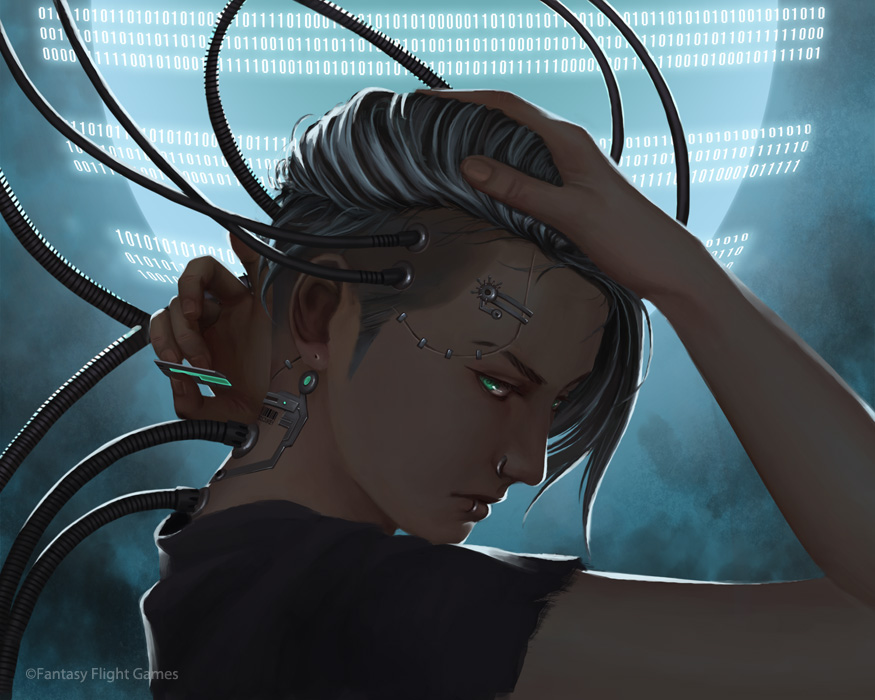
Slowly, but surely, we’re becoming cyberpunk.

I grew up in the 80s and 90s and saw cyberpunk stuff first at middle/end of the nineties. A lot of the cyberpunk imagery back then was taking current technologies and attempting to extrapolate them. The Internet was still new back then, so a lot of people thought it would evolve into some sort of virtual reality interface or use some direct feed into the brain, possibly something involving a large spike and wires, ala The Matrix. A lot of the other trappings,  as envisioned by books like Neuromancer or RPGs like cyberpunk 2020, tended to involve bulky machinery, like a cyberdeck, or cassettes and whatnot, as those worlds were imagined in the 80s where computing was a much “bigger” affair.

Cyberpunk, for those who don’t know, is a science fiction setting, which typically merges near-future high-tech, along with dystopian societal themes. As such, what feels “cyberpunk” tends to change as time goes on, as our current technology catches up to the imaginations of the authors. Some  trappings that looked possible 30 years ago such flying cars and monofibers, stubbornly fails to materialize, while others take their place which the authors didn’t imagine, such as widespread smartphones, instead of decks.

And it sometimes, you get some tech that actually matches cyberpunk imagination. For example the recent breakthrough in cyber/implant technology is still mind-blowing to me. We’re now at a level where we have people using mechanical extremities where scientists are effectively actually making neural connections between machinery and brain. We have the internet combined with mobiles phone in the form of affordable smartphone and tablets, widely reshaping how society behaves and organizes, much more than what we would expect even just twenty years ago.

As someone who’s seen many of my early cyberpunk imaginations come to life, I still couldn’t declare now is cyberpunk, because there is an important piece missing.

You see, cyberpunk is not just near-future tech + dystopia. Otherwise every generation would merely be the previous generation’s “cyberpunk”. Rather cyberpunk is how high-tech (and more specifically transhumanist tech) is implemented in a world to enhance its existing dystopian themes.

We have literal themes out of Black Mirror playing out in places like China, with their Orwellian surveillance and mandatory social credit system. We have actual crimes and even genocides (!!) being commited due to false news being spread via unchecked social media. However the thing that made me say “hold up now” and write this post, was reading this article about one of the most notorious “IRL streamers”: Ice Poseidon. This is like a caricature out of goddamn Transmetropolitan!

From my perspective, the tech that we have now, fits absolutely into my idea of what tech would look in the near-future of my childhood, and not only that, but this tech is widely being used to make the world a darker place. All the pieces fit!

Tell me which other examples of technology used in the service of dystopianism have you noticed yourselves.


The many questions on the death of Zak

Recently there was a horrific incident of public lynching in broad daylight in the middle of Athens. Part of the event was captured on video but there was a lot of details missing, like, how did he end up inside the shop, why did the police did an atrocious job collecting evidence (not closing the scene, moving things around etc).

Media nevertheless immediately jumped to label the victim as a junkie thief who got caught breaking in ((same way they tried to label the death of anarchist P. Fyssas as a football-related fight?)). As we only saw the part of him being already in the shop to begin with, it was difficult to oppose, but still, much of this narrative doesn’t make sense. Zak was obviously very addled and barely able to move, nevermind break in alone and leave quickly.

Quickly the medical judge announced that he didn’t die from the beatdown, but that the cause is “unknown”. Media further promotes this. Popular greek forums quickly promote all narratives painting Zak as a thieving junkie.

As days go on however, more and more details don’t add up about this story. Zak was apparently being involved in some altercation before entering this shop. The Shop itself looks like it was broken by the owner. The other assaulter was a rabid-homophobe who went home after the lynching and started posting anti-gay and victim-blaming texts on twitter.

And today another bombshell breaks. The police is caught on camera continuing the assault on an unconscious and bleeding Zak. The visibly seem to be carrying knife in their bare hands, disrupting any chance of investigating it and opening fears that they planted it themselves. They are visibly doing very dangerous assaults on the body, like stepping on its neck and violently jerking a bleeding person around, while the EMTs around are not being used. Simply barbaric stuff.

And the medical judge tells us the beat-down had nothing to do with his death? Right.

The media and right-wing social media onslaught is reaching peak levels as we speak. I posted the video of the police assault on reddit and it was burried with extreme prejudice. The reddit comments are swarming with right-wingers blaming the victim and praising the police for their actions, which shows the is an active campaign of disinformation here. I suspect because of fears of another “Grigoropoulos incident” are very real.

Given the amount of disinformation, evidence and witness testimonies that keep cropping up, and the character of Zak,  my suspicion is that this is a case of some sort of very obvious hate crime against LGBT, which was further exacerbated by brutality of the police who simply believed the perpetrators. So now we’re seeing a desperate and collaborative effort by the state and the right-wing to cover it up, and character-assassinate Zak, to avoid riots in the streets and justice for the victim.

This is a very raw story and I suggest you start paying a lot of attention and don’t let the right-wing command the narrative. There is a lot going on behind this event that is attempted to be covered up.

Can Overwatch one-trick drama be a good simulation of microaggressions for privileged people?

Yet another Overwatch flamewar is ongoing about the classic question of whether someone “one tricking” a hero ((This is the practice of only choosing that hero, regardless of map or opposing heroes)) in competitive should be a bannable offense or not. As always the “ban them” camp has the loudest or more numerous voices, even though the Overwatch design team has publicly stated that they disagree with this approach. This latest drama round was only started because an ex-Blizzard/Overwatch employee has publicly stated the opposite. Check the thread sorted by “controversial comments” to witness some nerdrage if that’s your thing today.

However as someone who habitually plays primarily “off-meta” characters ((This means characters which the “competitive scene” is not using, and as a result the  majority of OW players take to mean they are weak choices)) who’s spent significant time improving my skills with them, I’ve been often lumped into the “one-trick” corner by raging team-mates. In fact, playing off-meta characters is a more likely indicator that your team-mates will turn against you, rather than one-tricking as a practice, since if you’re tricking an in-meta characters, nobody bats an eyelid; but I digress.

What I want to suggest is that the experience of someone who plays off-meta/one-tricks in OW is going to be like a very very mild experience of microaggressions that marginalized people experience regularly. What tends to happen to people who make such choices in competitive play, is that there is a constant level of hostility and bothering that other players just don’t experience. From the mild, such as someone asking you very politely to switch your choice at the start of the game, to the overly hostile, such as someone flaming at you, or deliberately throwing the game to spite you.

On their own, each of these might not be an issue at all, or just a hilarious occurrence, respectively. Howevever where these situations start to approach the microaggression territory is when one experiences some form of them in almost every game they try to play. If in almost every game you play someone politely or aggressively tries to make you switch characters at some point in the match, then at some point even the most polite phrasing is not going to help the effect they have on your psychology.

While there are other games with hero choices, Overwatch is uniquely positioned to act as a “microaggression simulator” due to its mechanics which support a constant change of each team’s roster. Other games might have “off-meta” characters, but often due to the locked-in nature of each once the game starts, people tend to not rage on this issue that much. However in OW, people will keep annoying the off-meta choices for this exact purpose, with the comments often escalating in vitriol when the game is going bad and the off-meta player refuses to switch.

Now, reminder that I don’t think they are anywhere on the level of microaggressions a marginalized person receives, but they are a really good way for someone who otherwise would have too much privilege to even understand what a microaggression even is, to get a mild sampling themselves. Perhaps is might be something on which an understanding and respect for actual microaggressions might be built?

Meh

So…yeah

The janky mods of the Anarcho-Communism group in Facebook decided to ban me because I vented against U.S. Imperialism in a thread venting against cis people, in the same style the OP did. They piled-on me trying to prove that privilege-don’t-real if you’re poor, and deflected criticism by pointing out they’re not U.S. citizens themselves. Eventually I pissed one of them enough by applying the same logic to my arguments, that they muted me and asked one of their buddies to ban me.

Unfortunately this is par for the course for anarchist organizing on shit platforms like Facebook and that group had just devolved into the anarchist version of purge-bait. Here, I’ll give you a sample of the daily quality of posts:

“All people not in my oppressed class are crap!”

You now have seen 90% of the “content” posted in this group.

Unfortunately in too many public anarchist spaces, this kind of venting (that should normally be reserved for your affinity group) is par for the course, and then mods fall on top of each other trying to prove who is the best ally by banning whoever tries to use this as a springboard for discussion.

It’s all just immature fucking posturing by immature people who just discovered anarchism. Followed then by more posturing by the resident in-group who has 5% more power than the rest and wants a reason to exercise it. This shit is what passes for activism for many, and the reason why I have lost a lot of interest in trying to contribute as much as I used to in /r/anarchism.

The funny thing is how the people who are ban-happy when they think they’re on the right, cry foul when they end up on the opposite side, like a mod in reddit who whined about me oppressing them for reverting their deletion of a post ((It was nothing reactionary but rather a silly anarchism-related game they didn’t personally like)).

Now to be clear, there is nothing inherently wrong with banning or venting online, and neither of these acts, nor being a ban-happy fuckhead is isolated to anarchists, in fact right-wingers seems to be naturally more complacent and glad to fall in-step to a leader-figure. However there is something wrong when most online discourse on this subject is dominated by immature anarchists trying to prove how radical they are. Even more frustrating when they are stumped that they go digging into your profile and attempt to start an oppression olympics with you as a silencing tactic.

It had gotten so ridiculous at times that I managed to avoid getting banned for the longest time because I am Greek (and therefore “non-white” somehow? Dunno how that works, but whatevs) and could speak with some experience about U.S. imperialism. But someone from mainland U.S.A. making the same arguments would be banned without a second thought if they didn’t “win” at the oppression olympics at some other area. I.e. it stops being about what you say, and rather about who you are.

So, meh. Probably for the best as the group had just devolved into people daily calling each other “trash” and high-fiving each other about it in a group-masturbatory celebration of how progressive they are.

Why ‘noob’ is my favourite insult

‘Noob’ has its origins in the word ‘newbie’ which in turn simply means someone who is new to (usually) an online game and therefore has a fairly low skill at its gameplay. ‘Noob’ or ‘n00b’ in turn is  a slang term/insult to signify someone who is both a newbie at something, but at the same time has a very inflated sense of their prowess and capabilities at that task. Often that would be coupled with a bad-attitude as such people seem to be prime victims of the Dunning-Kruger effect.

The reason why I like to use it as an insult in most appropriate situations is that it connotes a lack of experience with an implied false sense of superiority/knowledge in one 4-letter word. It big advantage is that it’s not relying of ableism, whereas the insult is effectively comparing the accused to people with lower mental capacity or non-neurotypicality, which is something I’ve been trying to actively avoid doing.

Rather, being a noob is something entirely within one’s control; one merely has to recognize their lack of experience/ability and act accordingly. Therefore being compared to a noob is merely a one-two hit to one’s sense of skill and their attitude, which for many immature man-babies online, can sting even further.

To make matters even better, noob is the kind of word that can easily be used both playfully towards a friend, as well a more seriously towards someone who’s feelings you might want to hurt. Of course, it’s not appropriate in all contexts, but you’d be surprised in how many it can fit.


The equivocation of ‘censorship’

There is a common discussion that I see popping up whenever activists succeed in shutting down an event from some sort of reactionary, recent example being the cancelling of talk by notorious right-wing troll Milo Yannopoulos.

Among other arguments on the morality of events, I see people bringing up the idea that shutting down such events is censorship. As soon as this happens, usually an argument starts on whether it really is such. One side claiming that it is not because it’s not a state actor that is suppressing free speech, while the other is claiming that in the absolute technical terms, it totally is:

censorship
ˈsɛnsəʃɪp/
noun
1.
the suppression or prohibition of any parts of books, films, news, etc. that are considered obscene, politically unacceptable, or a threat to security.
“the regulation imposes censorship on all media”

However what seems to me is happening is rather some kind of equivocation. An equivocation in fact, between two meanings which on a word that don’t appear to be formalized yet as distinct in dictionaries.

Specifically, it there’s the popular concept of censorship which takes the above definition and adds “by state actors” in the end. Not only that, but more often than not, one will imagine also brutality involved and 1984-like images might come to mind. As a concept, this is the one that makes people icky.  In fact, this is the concept one attempts to invoke when they use it as the basis of the argument: “But it’s censorship!”

What is happening specifically is that all the unwritten baggage of “censorship”- which do not belong to its official definition but are attached to it anyway due to many years or red scare propaganda – are being used to undermine an act which does not share those characteristics at all!

The actual “censorship” currently happening, let’s call it censorship-lite for reference, might be technically accurate as a term to describe the effect, but if seen without relying on defining it, is quite a mild effect. In the case above it effectively involved people exerting peer (or sometimes market) pressure on some venues to not provide a platform to known reactionaries.

One would think, if such censorship-lite is not a big deal, why does it keep coming up from such valiant defenders of free speech (/s)? There is a further unspoken argument being packed in the accusations of censorship, in the form of the slippery slope fallacy. The point being made in subtext is: “This is how it starts, today you stop Milo Yannopoulos’ speech and tomorrow a boot is stomping a human face – forever.”

Please forgive my exaggeration but I hope it makes my point clear what is actually happening and why such arguments on the definition of the word never seem to lead anywhere.


Outrage Culture or Male Indignation

The latest Wondermark comic once again hits the spot perfectly, but I feel it also makes a secondary point more obvious to me. I’ve always wondered why so many dudebros online just get so unreasonably upset about someone calling them out on something, even the smallest issue in the most polite way, and I just realized that it’s not really “outrage” per se that they’re expressing, but rather a sort of pre-emptive indignation at someone pointing out they might be wrong about something.

In other words, it’s not really a case that someone is upset about SJWs taking over popular culture and other such nonsense, but rather a case that someone not wanting to accept or hear that they might have done something shitty.

The reason I think this is because it’s a classic result of toxic masculinity to react aggressively to any suggestion that they’re not perfect, or that someone else might be better at them at something. And it doesn’t have anything to do with how aggressive you are when you make such a statement, or even a specific subject. This reaction might be triggered from something as innocuous as a suggestion that they may not know as much about cars as another dude.

Toxic Masculinity then demands that they re-assert their dominance, and when they’re clearly in the wrong, their options are rather limited;  either unwarranted aggression to cower the opposition or denial and misdirection. Both of these examples are plentiful in the recent examples of reactionary outrage against feminist strides in online spaces. From the constant harassment of prominent women (and other minorities) online in an attempt to silence them, to “sealioning”, to conspiracy theories and constant regurgitation of debunked lies.

So, in the end, I feel a lot of the reaction I see from dudebros is not really truly an expression of outrage culture ((even though I find it exquisitely funny how this is another perfect case of dudebros perfectly exemplifying a concept they claim to be railing against)) but rather a case of classic male indignation to the idea that someone else might be better than they are at a subject.