For a while now I’ve been discussing with LAION on a way to use the power of the horde to help them in some fashion. After coordination with hlky from the Sygil.dev crew, I decided to provide an opt-in mechanism for people to store their text2img stable diffusion generations in an alternative storage bucket. This bucket in turn will be provided to LAION so that they can use it for aesthetic training, or for other similar purposes.
So today I finally released this new mode. For clients it’s a simple flag during the payload. Set “share” to True, and your request will be uploaded to the specific storage bucket. This will also save me infrastructure costs as I will not have to pay for the storage out of my own pocket for these.
To give a further incentive for people to turn this on, and because I wanted a way to show the cost of running the horde, I have also implemented a “horde tax” kudos burn. Every time you generate an image, the overall kudos cost is then increased by 3. This signifies the overall resource cost of passing through the horde, such as bandwidth, i/o and storage. However, if you opt to turn on the sharing switch, the overall “tax” is just +1 kudos.
You might ask, why not make the cost proportional to the overall kudos cost. Something like +30%/+10%. The reason is that the overall kudos cost is dependent on how difficult it is for the workers to generate that image. From the perspective of the horde, a 512x512x50 image is not much different from a 1024x1024x300 image, even though the latter would take an order of magnitude more time to generate.
In fact, many small requests are technically worse for the horde infrastructure costs, than a few small ones. It’s not that I want to discourage the small ones though, because they are actually good for the horde workers (and thus the overall generation speed). Therefore the “tax” is fairly trivial in the grand scheme of things. Just a bit of extra “burn”.
One important thing to note however, is that anonymous accounts image generations are always shared. This is part of my general strategy where I want to discourage anonymous use of the horde. It just more difficult to manage the load when people are using it like that. This is why anonymous has the lowest priority and the most restrictions. And now they will always help provide data to LAION as well.
Finally, img2img and inpainting requests are never shared. This is because those are based on existing images and I cannot know if someone used some personal photo at low strength or something. So I prefer to err on the side of caution.
This is not the last support the AI Horde plans to give to LAION either. We are already working on new features like an aesthetic rating trainer and so on. I hope this sort of assistance can be put to good use for the benefit of all humanity!
I wonder what effect #AI generated text like #GPT will have on internet spam. Until now, our anti-spam filters were trained heuristically to try and recognize typical spam patterns, but now spammers could turn into AI models to generate unique text to mask their spammy messages on emails, social media and blogs. Imagine spam links wrapped in elaborate text about any subject you can conceive of. And if the site link behind it is novel each time, it will be increasingly unfeasible for administrators to figure it out.
Not only that, but a lot of sites use minimum active account life to figure out which accounts could be spam. Such accounts are marked based on site interaction and ratings which either forced spammers to buy account, or set up spam farms with people doing nothing but interacting natively on social media until their account was live long enough so that it could bypass spam filter.
Now spammers can simply plug an text AI behind each account and have it run on autopilot for a few months, until they flip on its spam switch, and it transparently starts peppering spam links in its normal posts, which would make the switch almost indistinguishable unless it posts a well known spam site or something. They could even target specific subreddits and train finetuned generative models on the typical posts of users in there, which will even make it fits the typical subreddit pattern extremely well.
I also expect anti-spam to turn into their own AI models to catch them, but I wonder how much this countermeasures can help. It could be that a model could be trained to figure spam patterns a human cannot distinguish, but I’m curious to see how effective it could be. I suspect an easier solution would be to have an AI check the site behind each link and try to figure out if it’s a spam site or not, based on heuristics a human might take too long to figure out.
I have the feeling however that ultimately this is a battle that countermeasure AI is bound to lose. And if that happens, it will start leading to what I suspect will be a internet-wide dissolution of anonymous trust. But I will write about that in a latter post.
Another great update has landed now that the AI Horde Worker is in its own repository, a Web UI built with Gradio! All kudos to ResidentChief who has been doing amazing work for the horde lately!
The new WebUI is completely optional and it can run alongside either the Stable Horde worker or the interrogation Worker, allowing you to tweak their settings on the fly through a very simple interface. This should make it significantly easier for people to adjust their settings.
It still needs some work (I would like some information popups for each feature), but this should work for now. Soon we’ll add things like worker control (maintenance on/off etc) as well as user information and stats.
To run the new worker, simply call bridge-webui.cmd/sh
This should also nicely allow someone to update their bridge setting while sitting on their couch and AFK. Maybe we can add to it things like bridge control, allowing it to start/stop the worker through it. Many exciting possibilities!
The Nataili ML backend powering the workers of the Stable Horde has for a while now supported models which can perform image interrogation (AKA img2text) operations. For example captioning images or verifying whether they are displaying NSFW content or not. For almost as long, I’ve wanted to allow the AI Horde to facilitate the widespread use of those models, the same way we do for Stable Diffusion.
A primary reason for wanting this is the fact that the requirements to run a worker on the horde are fairly heavy, needing at least a mid-range GPU on your PC and most people just don’t have the capacity to provide that. Yes there is always a chance to run generations on free cloud services like Google Colaboratory, but that replaces cost with time and attention.
So I felt that being able to use models which are fairly low-powered and can run even on CPUs would provide a way for almost everyone to join the horde and start gaining kudos for themselves. The final push I needed to do this was discovering that there was useful accessibility browser extension out there which had already ceased operations because they couldn’t find cheap compute. Which is effectively what the horde has been built to do!
I was planning to get this done 2 weeks ago, but unfortunately I got massively sick during the holidays so I couldn’t do much of anything. So I moved my vacation days to the new year and finally got cracking.
Unfortunately, while the implementation of those models is much simpler than stable diffusion, preparing the AI Horde to be able to serve these was not quite as straightforward. The problem being that until now I built the horde under two core assumptions:
The input is going to include a prompt of some sort on which to run inference
The prompt would always expect the same type of results. Whether that is image or text.
Image interrogations flip these lot of these on their head. The input has to be a simple image, with no prompt from the user (other than payload tweaks), and the end result can differ wildly from each other, for example one being text, the other boolean and yet another returning a dictionary.
So I needed to set up a way to do that in a way that I hadn’t engineered until now, which required building the pipeline inside the AI Horde from scratch.
To make things worse, I did not want to duplicate my worker code, something which required me to implement table polymorphism within SQLAlchemy, which is a tricky subject on its own. More importantly, it requires modifying existing tables, which meant I needed to set up a development instance of the stable horde so that I can actually test the changes before going live. That in turn meant a new server, new DB, new nodes etc. Happily I had most of it ready via my Ansible code, but I still needed to tweak things to run on a new domain etc.
Finally this also required that I implement polymorphism on the bridged worker as well. The existing worker code has evolved to use quite advanced mechanism for queuing, threading etc and I didn’t want to just duplicate it. Unfortunately the code itself has become very spaghetti and is was high time I de-indented it with extreme prejudice and then implement worker polymorphism as well.
All-in all, designing, building and testing image interrogations took me the best part of a whole week.
So I am proud to announce that the new feature is now live on the stable horde!
Response Body from an image interrogation request
As always, you have to look at the api documentation for each endpoint you want to use. But very simply, you simply send an image URL you want to interrogate and specify which interrogation forms you want to use, like so:
It otherwise works similar top image generation from a client’s perspective, with the difference that you don’t need to use a check/ endpoint, and you can keep polling the interrogate/status/ endpoint directly. Once a form is completed, you will get a result from that form matching its type.
Currently we support three interrogation forms: caption, nsfw, and interrogation
Caption: Returns a string describing the image
NSFW: Returns a true/false boolean depending on whether the image is displaying NSFW imagery or not.
Interrogation: Returns a dictionary of key words best describing the image, with an accompanying confidence score. This takes the most time of all the interrogations and is rewarded accordingly in kudos.
As I mentioned before, the worker code had to be completely refactored. It now lives in a new repository as well as the nataili repo will soon turn into a pip package I can install externally, so this is in preparation of that.
To start an interrogation worker, you use the same code, but you start with a different bridge script.
./horde-interrogation_bridge.cmd -n "The Deep Questioning" --max_threads=5 --queue_size=5Code language:JavaScript(javascript)
As the models used by the interrogation worker are much more lightweight, it actually benefits more from high threads and high queue_sizes, so feel free to crank those up so that it’s best utilizing your worker. A lot of the new code changes I did to the horde also allow your worker to pick up many forms at the same time, which will cut down on the poll requests to the horde, further reducing idle time.
However be careful not to set these too high. because you’re picking up the requests in advance, nobody else will work on them until your worker gets to them. If your queue is high and your threads are low (or slow), then you’ll notice your horde performance is not going to be great.
However the result of each form will be sent back as soon as it’s done, so as it save as much time as possible.
One more thing to note is that an Interrogation worker is different from the Stable Diffusion worker. As such you cannot use the same name! However they DO use the same bridgeData.py. If you plan to run both types of workers, utilize the command line arguments to tweak the bridge settings accordingly instead of having to change your bridgeData.py all the time.
In the future I plan to further tweak the bridge so that it can run parallel with the stable diffusion worker to best utilize your space processing. I also want to tweak the model loading so that optionally you can offload the whole thing to CPU. But I need to test if the speeds for this make sense first.
Another cool possibility from this refactor is that it opens the doors for different worker types on the horde, which in turn gives me an opening I’ve been considering for a while now, which is the complete merge of the Stable and KoboldAI horde into one service. This will reduce the amount of code juggling I have to do, and hopefully simplify things for everyone with a common kudos system.
I am excited to see what use cases you all will come up with this new system!
A very cool person has developed a FOSS mobile app! This works both on Android and iOS.
It is not quite as feature complete as the other stable horde web clients like Artbot and Stable UI (which also work on phones perfectly well), but I’m sure it will get there very soon!
For the past 2 weeks I’ve been trying to build the new feature of the horde which will allow even people with a low powered GPU, or just CPU to join the horde and provide a service to gather kudos.
It is called “Interrogation” as it will “interrogate” source images to discover aspects about them, such as an image caption, or whether they are displaying NSFW content etc. This feature can then be on-boarded into new or existing tools, such as perhaps automatically captioning images for micro-blogging services as an accessibility feature, or a browser plugin for parental controls etc.
However what I thought would be a bit tricky but doable soon keeps running into various snags. First, I lost one complete week of work from my vacation by getting the nastiest cold I’ve had for the past 10 years at least. Flattening me for almost 9 days. Then it was holiday period where I had to put more attention to family and friends.
Now that I’m finally able to concentrate more on it, I find it’s actually an order of magnitude more complex than I initially expected, requiring me to actually have to update my existing database tables (always a risky proposition) and also redesign my approach to use such things as “Polymorphic tables” so that I don’t end up duplicating hundreds of lines of code between similar classes.
And while I’m doing this, the horde ML backend has been receiving a surprisingly increased pace of improvements, recently implementing depth2img, adding diffusers to voodoo-ray, CodeFormers and a ton of urgent bug-fixes and other improvements.
To say my attention has been split is an understatement.
But I’m slowly but surely making more progress. I hope to have something out soon-ish. I do wonder if it will require a complete horde downtime this time for the DB upgrades. Never done that before. Kinda scary, not gonna lie…
Through the great work of @ResidentChiefNZ The Stable Horde now supports depth2img, which is a new method of doing img2img which better understands the source image you provide and the results are downright amazing. This article I think explains it better than I could.
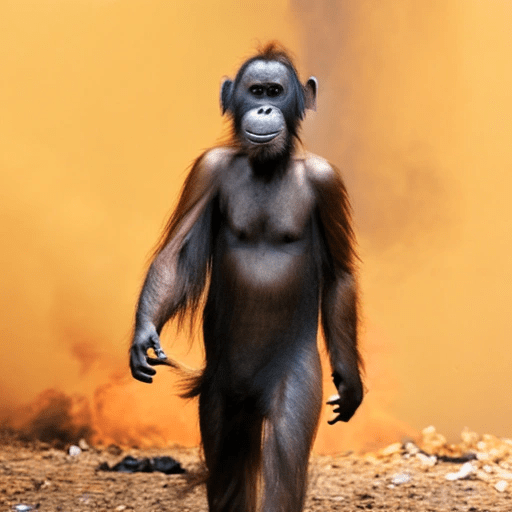
See below the transformation of one of my avatars into a clown, a zombie and a orangutan respectively.
To use depth2img you need to explicitly use the Stable Diffusion 2 Depth model. The rest will work the same as img2img.
Warning, depth2img does not support a mask! So if your client allows you to send one, it will just be ignored.
If you are running a Worker you can simply update you bridge code and you mustupdate-runtime as it uses quite a few new packages. Afterwards add the model to your list as usual.
We recently also enabled diffusers to be loaded into voodoo ray, so this will allow you to not only keep the depth2img in RAM along with other models, but also the older inpainting model! Please direct all your kudos to @cogentdev for this! I am already running both inpainting, depth2img, sd2.1 and 15 other 1.5 models on my 2070 with no issues!
If you have built your own Integration with the stable horde such as clients or bots, please update your tools to take into account depth2img. I would suggest adding a new tab for it, which forces Stable Diffusion 2 Depth to be used and prevents sending an image mask. This is to avoid confusion. This will also allow you the opportunity to provide some more information about the differences between img2img and depth2img.
Enjoy and please shower the people behind the new updates with Kudos where you see them!
Overall a very well researched article. I can’t find any issues with it. Personally I would liken the AI Horde technology as a mix between BitTorrent and Folding@Home, but the former has some negative connotations for many people.
Some things I could address from the article
It’s not entirely clear whether every fork of Stable Diffusion should work, but you can try.
There’s no “forks” of stable diffusion. There’s checkpoints and multiple models and the horde supports every .ckpt model and some diffusers models. I suspect the author confused Stable Diffusion the model, with clients and frontends using it, like automatic1111.
There is a tiny bit of a catch: the kudos system. To prevent abuse of the system, the developer implemented a system where every request “costs” some amount of kudos. Kudos mean nothing except in terms of priority: each request subtracts kudos from your balance, putting you in “debt.” Those with the most debts get placed lowest in the queue. But if there are many clients contributing AI art, that really doesn’t matter, as even users with enormous kudos debts will see their requests fulfilled in seconds.
Indeed each request consumes kudos to fulfill, but you don’t actually go in debt. While we do record the historical amount of kudos you’ve consumed for statistics, your actual total as a registered user never goes below 0. This means as a registered user, you will always have more priority than an anonymous user (who typically remains at -50 kudos). Your kudos minimum also allows you to generate with slightly higher resolution and steps than an anonymous user.
Images won’t automatically download, but you can go to the Images tab and then manually download them.
That it totally dependent on the client. It works this way for Artbot, but Lucid Creations for example is a local application, so the images are saved with a button click. Other clients might save automatically.
Other than that, great article!
To be honest, I’ve been actually quite surprised that nobody has written about the SH until now. The SH went live in early September, soon after Stable Diffusion came out, and we’ve generated 13 Million images until now (or approximately $50K of value) but none of the big AI and AI Art focused news reports has given a single mention of it! Now, I am not one for conspiracy theories, but it sounds extraordinary unlikely that absolutely nobody in the scene has noticed us until now or felt we are newsworthy, especially since many people have directly tweeted to some of the big AI and Stable Diffusion players about it.
Oh well, a PC-magazine is the first to report on the Stable horde. So be it! I wonder how many people will discover the Stable Horde from it.
We need people to test a PR for onboarding stable diffusion inpainting onto voodoo ray. Please pull this branch and load inpainting and see how stable it is and/if the VRAM is unloaded correctly after each image.
Close
Ad-blocker not detected
Consider installing a browser extension that blocks ads and other malicious scripts in your browser to protect your privacy and security. Learn more.